


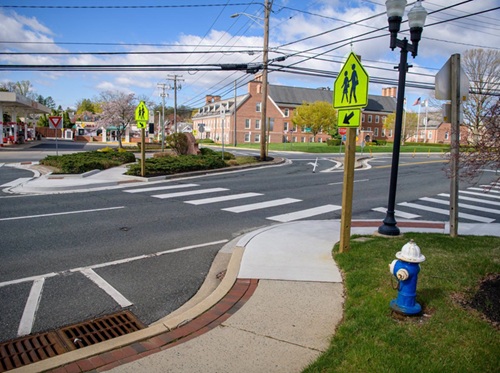
The Maryland Department of Transportation recently celebrated the two-year anniversary of its Complete Streets Policy; a department-wide commitment to building safer, more accessible, and more equitable transportation networks for everyone, including people walking, biking, rolling, riding transit, and driving.
[Above photo by David Trozzo for the Maryland DOT]
Adopted in June 2024, the agency said the policy established a framework that requires transportation projects to be planned, designed and implemented with all users in mind. It reflects Maryland’s commitment to safety, public health, economic vitality, environmental stewardship, and equitable access, Maryland DOT noted.
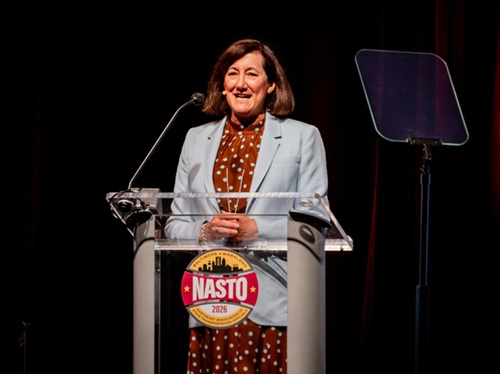
Major achievements during the first two years of the Complete Streets Policy include:
- Upgraded more than 1,300 crosswalks, reconstructed 11.26 miles of sidewalks, and built 13.34 miles of new sidewalks to enhance safety for all users, including pedestrians and bicyclists;
- Identified 23 projects in various travel corridors for safety improvements as part of the Pedestrian Safety Action Plan or PSAP. Projects are in various planning, design and implementation stages, with construction completion expected this fall on the first PSAP project on MD 650 (New Hampshire Avenue) in Montgomery and Prince George’s counties;
- Initiated 10 quick-build safety projects across the state, designed to pilot short-term, easily implementable, innovative improvements and address existing vulnerable road user safety needs;
- A record $500+ million investment in active transportation projects programmed into the department’s six-year capital budget; and
- A new Maryland Transportation Trails Strategic Plan, updated in 2025 for the first time in 16 years.
Maryland DOT added that efforts spurred by its Complete Streets Policy helped reduce fatal crashes by 18 percent statewide in 2025 compared to 2024, with the largest reductions occurring among people who walk, bike, and roll.
The agency added that this policy is also a key component of the Maryland DOT’s Serious About Safety initiative, a department-wide commitment to advance improvements that drive safety goals and save lives.
“Two years in, the Complete Streets Policy is delivering real results for Maryland communities,” said Katie Thomson, Maryland DOT secretary, in a statement. “By prioritizing safety, accessibility and multimodal connectivity, we’re building a transportation system that works better for everyone.”
[Editor’s note: Other state departments of transportation have also established Complete Streets endeavors, including the South Carolina Department of Transportation in February 2021, the California Department of Transportation in December 2021, and the Connecticut Department of Transportation in September 2023, to name just a few.]
Across the state, visible improvements are underway, including expanded sidewalks, safer crossings, corridor redesigns, quick-build safety projects, and enhanced data tools – developments that came in part from embedding Complete Streets principles into project planning, design, and decision-making across all transportation modes, the agency said.
“[Our] commitment to the Complete Streets initiative is demonstrated through the work of the safety-focused projects being developed and delivered across Maryland that support the mobility needs of pedestrians, bicyclists, motorists and all highway users,” said noted Will Pines, administrator of the Maryland DOT’s State Highway Administration. “This initiative offers the guidance and tools necessary for SHA to provide a safe, connected and accessible transportation system that our customers can rely on.”
“Maryland remains steadfast in its commitment to eliminating all traffic fatalities and serious injuries across the state’s transportation network. While the progress made over the past two years is encouraging, there is still important work ahead,” noted Chrissy Nizer, administrator of the Maryland DOT’s Motor Vehicle Administration, who also serves as Governor Wes Moore’s (D) Highway Safety Representative.
“Every road user has a role to play in improving safety,” she said. “That means slowing down, driving and riding sober, staying focused behind the wheel or handlebars, and sharing the road responsibly with everyone – including pedestrians, bicyclists and motorcyclists.”
 States
Larry Flynn Named as Director for Montana DOT
October 2, 2026 States
