


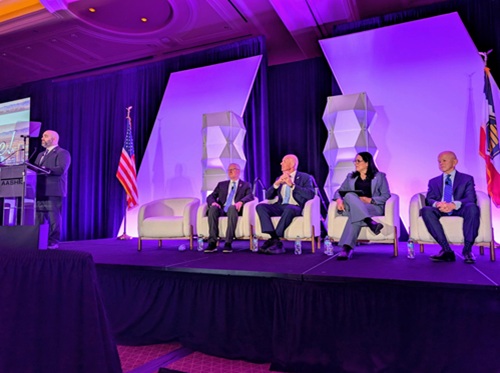
The general session at the American Association of State Highway and Transportation Officials 2025 Annual Meeting in Salt Lake City provided an overview of the challenges and opportunities states face when managing transportation for large-scale planned events.
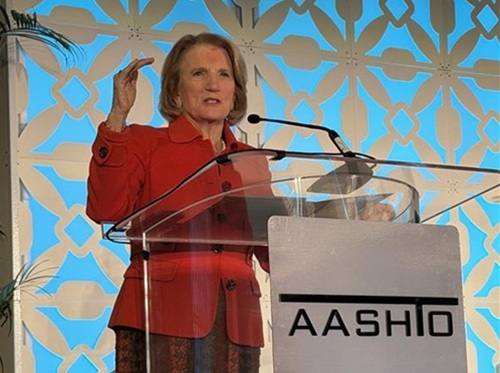
[Above photo by AASHTO]
Michael Huerta, former administrator of the Federal Aviation Administration, provided some perspective on that topic during his keynote address at the general session – drawing on his experience as managing director of the Salt Lake Organizing Committee for transportation at the 2002 Winter Olympic Games.
A discussion on the subject followed Huerta’s speech. Moderated by Garrett Eucalitto – commissioner of the Connecticut Department of Transportation and AASHTO’s 2024-2025 president – the panel featured Huerta; Russell McMurry, commissioner of the Georgia Department of Transportation and now AASHTO’s 2025-2026 president; Carlos Braceras, executive director of the Utah Department of Transportation and a former AASHTO president; and Dina El-Tawansy, director of the California Department of Transportation.
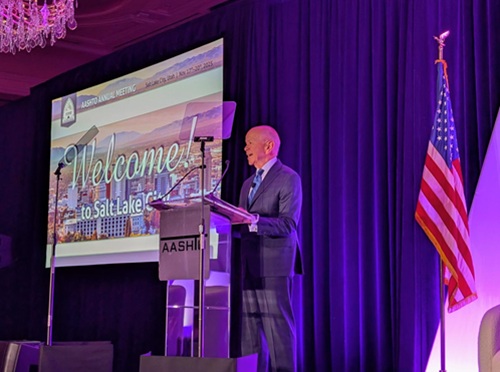
“I have been blessed to work in many senior roles across the transportation industry,” noted Huerta in his keynote speech. “And, like all of you, I have seen firsthand how transportation plays an enabling role for virtually everything that we do as a society. It provides access to opportunity and to recreation; whether we’re just trying to get across town to work or across the ocean for vacation or for business. The work that all of us do connects people all around the world.”
He added that transportation professionals are also, at heart, problem solvers – whether dealing with an incident that’s holding up traffic or planning for the long-term needs of a growing region. And it is that problem-solving mindset that is key to managing large-scale events.
“We need to focus on tactical challenges while at the same time considering how to enable future mobility; that’s what ‘problem solving’ delivers,” Huerta noted. “When we host a major event in our state or in our region, the conversation inevitably turns to whether the transportation system is going to be up to the task – or will it be a bottleneck.”
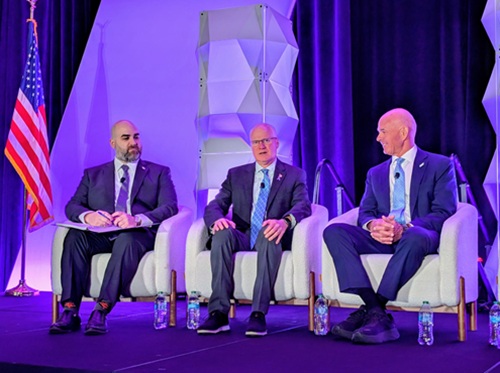
CTDOT’s Eucalitto said the issues created by “planned special events” or PSEs revolve around unexpected traffic delays and congestion, largely due to increased system demand and reduced roadway available for vehicles – or a combination of the two.
“As a result, that has major impacts on travel, safety, mobility, travel time, reliability across all surface transportation modes and roadway facilities,” he said. “We know planning [for PSEs] take a lot of preparation time, sometimes many years. They range from college football games to Taylor Swift concerts and solar eclipse viewing. Many of us have to deal with the Super Bowl or FIFA World Cup games coming up next year. Yet with foreknowledge of an upcoming PSE, state agencies have a valuable opportunity to create event-specific plans that incorporate proactive management and response strategies – as well as fostering direct engagement with communities that can be most impacted by those events.”
Caltrans’ El-Tawansy noted her department is planning for FIFA World Cup games in 2026, the NFL Super Bowl in 2027, and then the Summer Olympics in Los Angeles, happening in 2028.
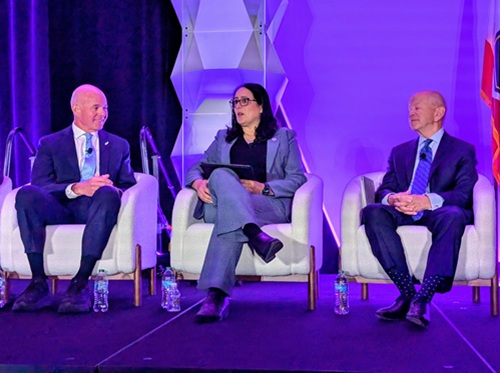
“Just think about the number of visitors that we anticipate in the region from those events,” she said. “We’ve got about 15 million that we’re expecting during some of those events, especially the Olympics. So that’s going to generate a lot of movement. We’re also looking at roughly 11,000 athletes that are going to be visiting our region [for the Olympics]. So it is a lot. But we also have all the regular traffic incidents that we manage on a regular basis, then climate stressors such as wildfires and how they impact transportation. Incorporating all of that along with ongoing special events is a really important point for us.”
Georgia DOT’s McMurry said that at the heart of his agency’s preparation for PSEs is making connections with the diverse audience of individuals attending them – people who might be different from those who normally use his state’s transportation networks.
“It’s a different mix, a different group, for each event,” he said. “For example, we find that for football games, people want to drive their cars and arrive early, at various times, to tailgate – then leave all at once. But for soccer games, they arrive more by transit and do not come as early.”
And those differences drive the messaging state DOTs need to conduct in advance of PSEs, McMurry stressed.
“Are they familiar with your city or are they from out of town? Do you want to direct people to travel in a particular way, or are you trying to anticipate what’s going to happen and just react to it? That’s a really important distinction, because if you want to direct people to follow particular routes, to take particular modes of transportation, then you’re going to want to work with the organizers to make sure that message is going to those ticket holders, and you’re going to want to be educating your general population of where they should NOT go on the day or days of the event,” he noted.
Utah DOT’s Braceras said that “audience analysis” will be critical to ensuring the right transportation plan is developed and deployed – especially when managing more than one PSE at the same time, such as a college football game alongside a Taylor Swift concert.
“So, first the athletes and the officials needed to support that event. You want to make sure that they have a very clear, seamless, frictionless transportation path to their events. They get there on time – it’s smooth and easy,” he said.
“The next one, which I first didn’t really appreciate the importance of, is a transportation plan for the media – because you want the media to have a great experience,” Braceras said. “You have to think it through, because the media is not really good about actually following the plan you have. They’re going to try to chase a story; there is going to be some randomness to them. But you need to set up a separate communication path to the media so that you can have immediate feedback from them.”
Then there are the spectators attending the event. “You have to need a way of communicating directly to the ticket holders – email and texting – so they have up-to-date information in real time,” he noted.
“And then the final audience – the ones not all that excited about the event in the first place,” Braceras said. “They’re going about their day-to-day life and they just don’t want to get into the traffic. They just want to get the jobs. They want to get to the supermarket. They want to live their life. And so each one of those different audiences for a special event have specific transportation needs and you really need to think through how you’re going to communicate with them.”
 Top Stories
Congressional Leaders Detail Key Transportation Priorities
February 27, 2026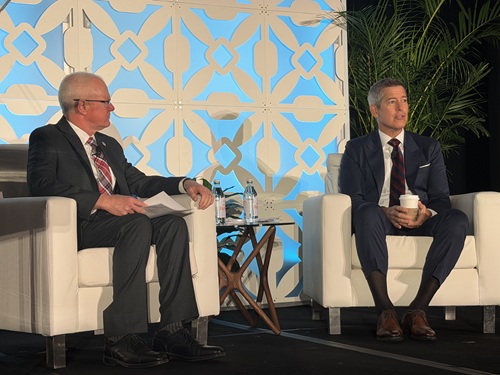 Top Stories
