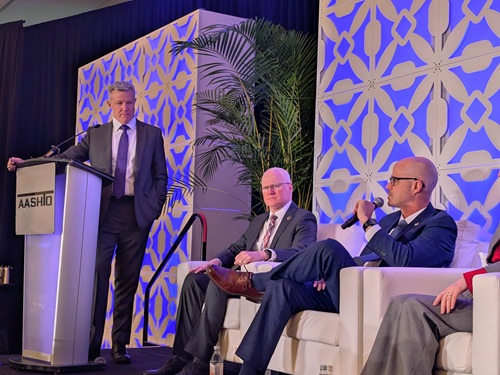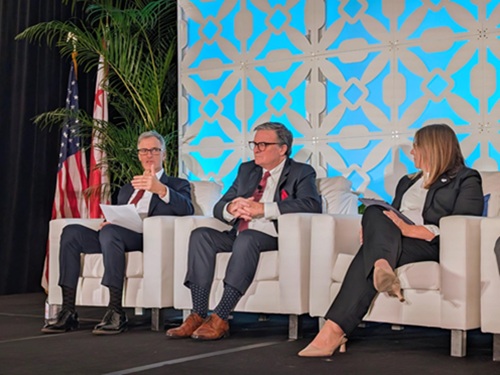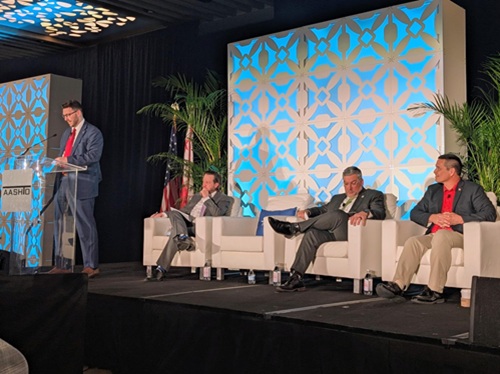
The American Association of State Highway and Transportation Officials recently hosted a knowledge session at its 2026 Washington Briefing in Washington, D.C., that examined how many states are working to assume more National Environmental Policy Act or NEPA responsibilities from the federal government.
[Above photo by AASHTO]
Jim Ray, corporate president for engineering consulting firm HNTB – which presented this session – moderated a panel discussion that featured Will Reid, commissioner of the Tennessee Department of Transportation; Ed Sniffen, director of the Hawaii Department of Transportation; and Jay Payne, deputy administrator of the Federal Highway Administration.
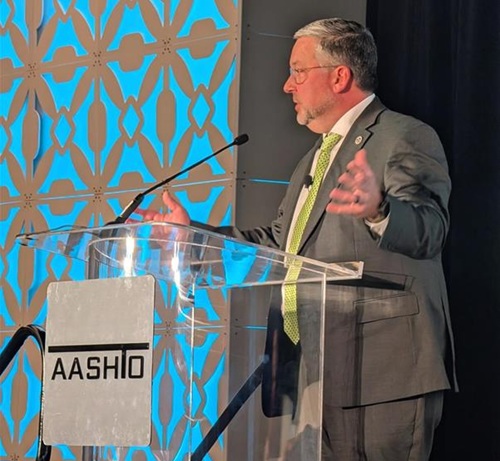
“We have to be committed to this process of expediting project delivery,” explained Reid, who became the first career staff member of the agency to become commissioner after his appointment by Governor Bill Lee (R) to that position in July 2025.
“We’ve gotten caught up a lot in the push and pull between authority and accountability and in the process lost sight of our ‘North Star,’ which is project delivery,” he explained. “We got bogged down in process; bogged down in a lot of back and forth that really didn’t affect project outcomes.”
For that reason, taking on more NEPA assignment duties from the federal government helps states move from a more “risk averse” project development process to a more project delivery-driven organization.
“We need to manage risk and align accountability between our people and our goals – and be judged on our ability to deliver projects,” Reid stressed. “And we need leadership committed to doing that so we create a clear line of sight down to our staff so they see that. Also, what [processes] we put in place must stand the test of time, because leadership comes and goes.”
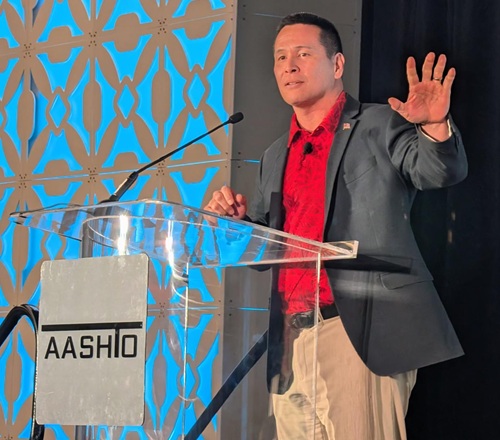
Hawaii DOT’s Sniffen echoed Reid’s assessment, noting that “for far too long, the vision of what project delivery looked like in our state was affected by process. Now we are getting closer to the vision we have by taking on NEPA assignment [from the FHWA]. We are all in on this so we can guide and control our future.”
Sniffen said one advantage for Hawaii DOT is that “many states have gone through this [NEPA assignment] already so we have learned from them.”
That’s also helped in terms of tackling “one of the biggest discussion points” Hawaii DOT has had with state legislators regarding taking on NEPA assignment duties, he said: waiving sovereign immunity.
“Many of our legislators were worried. But we knew we could defend ourselves better, take on risks better, by doing this,” Sniffen pointed out. He added that showing legislators how taking on NEPA assignment helps the agency “three times over” by reducing the number of environmental reviews really helped. “That made it easy to move forward,” Sniffen said.
FHWA’s Payne stressed that because state DOTs are “much more sophisticated now,” the state-federal relationship needs to be “recast” to reflect that new reality.
“We need to empower our state DOTs,” he said. “Our goal is to empower you and to give you the tools to build. That means focusing on the proper federal role in project delivery because the real work is done by the state – the state DOTs know their roads better than we do.”
Payne added that states taking on more NEPA responsibilities will ultimately decrease project timelines and increase value to taxpayers. “The proper federal role is to help things run smoothly in a simplified and standardized way,” he explained. “State DOTs are incredibly valued partners for building roads and bridges; they can deliver projects better on their own internal timelines. We can’t do that from desk in Washington.”