



Governor Laura Kelly (D) (seen above) recently highlighted 11 recipients of $10 million in total funds via the state’s Broadband Acceleration Grant program to make high-speed broadband access available across 10 rural counties.
[Above photo via the Kansas Governor’s Office]
Launched in 2020, the Broadband Acceleration Grant is a 10-year $85 million program funded via the Kansas Department of Transportation’s Eisenhower Legacy Transportation or IKE program. This broadband expansion program – administered by the Kansas Office of Broadband Development – has awarded $70 million in grants since 2020.

“We’re continuing to deliver on our bold and ambitious goal to make Kansas a top 10 state for broadband access by 2030,” Gov. Kelly said in a statement. “Affordable broadband is necessary for our communities to remain viable and competitive, and every Kansan deserves a reliable connection to the world. These grants accelerate our efforts to make that a reality.”
“Broadband infrastructure is as critical to the well-being of Kansans as are safe roads, bridges, and drinking water,” added Julie Lorenz, secretary of the Kansas DOT. “These IKE-funded grants, when combined with [federal] broadband funding opportunities enable Kansas to strategically and efficiently expand quality broadband infrastructure throughout our state.”
These recent state-level broadband investments in Kansas come on the heels of a new national program launched by U.S. Department of Commerce on May 13 called the “Internet for All” initiative, which seeks to invest $45 billion to provide affordable, reliable, high-speed internet across America by the end of the decade.
Administered and implemented by the Commerce Department’s National Telecommunications and Information Administration, the initiative’s funds come from the $1.2 trillion Infrastructure Investment and Jobs Act or IIJA, enacted in November 2021.
The “Internet for All” initiative funds three separate programs with IIJA funding:
- Broadband Equity, Access, and Deployment or BEAD Program($42.5 billion)
- Enabling Middle Mile Broadband Infrastructure Program($1 billion)
- State Digital Equity Act programs($1.5 billion)
To participate in the BEAD Program, states and other eligible entities must submit a letter of intent and a planning funds budget, which will unlock $5 million in planning funds and allow states to begin creating their five-year action plan.
Each state will have direct support from dedicated NTIA staff through every step of the process and a guaranteed minimum allocation of $100 million, with additional funding determinations made based on the forthcoming coverage maps from the Federal Communications Commission.
 States
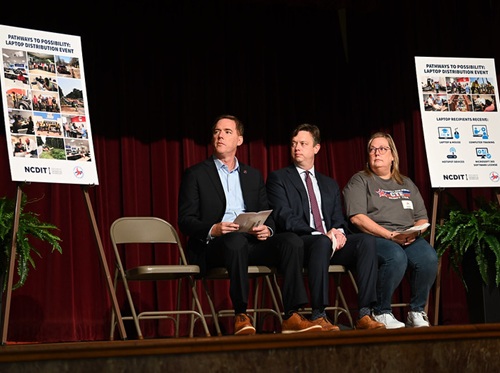
NCDOT Helps Donate Laptops to 700 State Residents
August 21, 2026 States
