


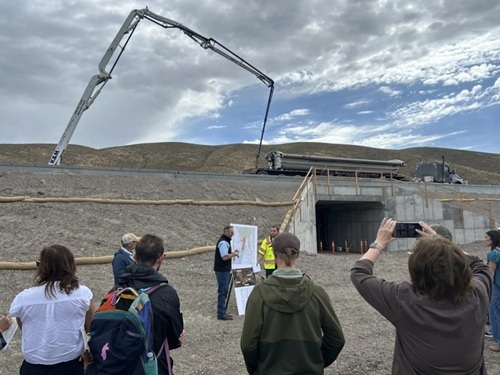
The Idaho Transportation Department recently conducted a tour of the Rocky Point wildlife crossing on US-30 – located in the southeast corner of Idaho, just 10 miles from Wyoming – for Congressional staff and industry stakeholders.
[Above photo by ITD]
ITD explained that the Rocky Point wildlife crossing – scheduled to be completed this fall – is comprised of three highway underpasses that uses two box culverts, a bridge, and fencing to safely funnel animals away from motor vehicle traffic. That fencing also features numerous “jump-outs” to give deer an easy way to exit the highway in the event they get on the wrong side of the wildlife funneling area.
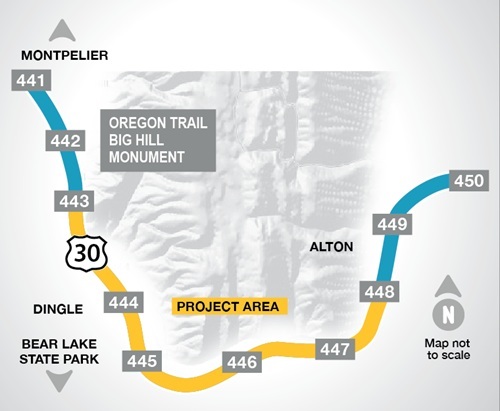
The agency said where US-30 threads between two mountain ranges split by the Bear River – and area known as Rocky Point – is a key migration passage for mule deer.
Twice every year, thousands of deer migrate through the narrow canyon and over US-30, which typically resulted in more than 100 wildlife-vehicle collisions annually, with the cost of those collisions alone at Rocky Point adding up to $2 million per year.
“[Our] primary responsibility is the safety of the travelling public,” said Bo Frasure, ITD project manager, in a statement. “With approximately 100 wildlife-vehicle collisions a year at Rocky Point, this project’s need was clearly apparent. By funneling wildlife through underpasses, the animals are kept off the road and safely away from traffic.”
ITD conducted the tour in cooperation with the Greater Yellowstone Coalition, the Idaho Conservation League, and the Idaho Department of Fish and Game (IDFG) – hosting staff from the offices of Sen. Mike Crapo (R-Idaho), Sen. Jim Risch (R-Idaho), Rep. Mike Simpson (R-Idaho), and other regional decision-makers.
“This project is about more than moving wildlife across the road – it’s an investment in public safety and the mule deer resource in this part of the state,” said Dan Garren, regional supervisor for IDFG’s Southeast Region. “What makes it especially meaningful is the overwhelming support from agencies, hunters, conservation groups, and the community. Mule deer are central to our outdoor heritage, recreation, economy, and way of life here.”
ITD secured a $20.8 million grant from the Federal Highway Administration’s Wildlife Crossing Pilot Program to help pay for the Rocky Point crossing; a grant that covered about 98 percent of the construction costs for the trio of underpasses.
An additional $1.2 million from the U.S. Department of Agriculture is funding a portion of the fencing to connect two of the structures in the heart of the mule deer travel route.
 States
Chris Dorrington Leaving Montana DOT on October 1
September 3, 2026 States
