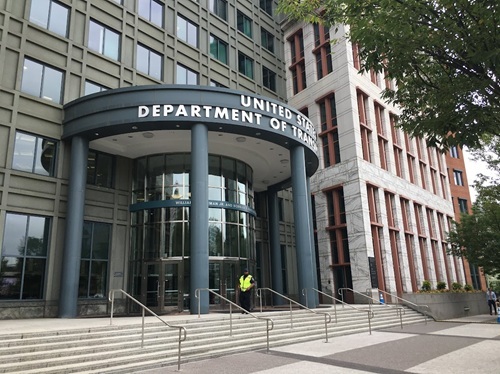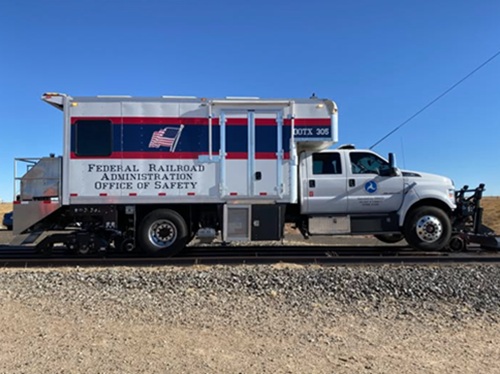
The Federal Railroad Administration’s Railroad Safety Board recently approved a new five-year waiver allowing U.S. railroads to expand field testing of automated track inspection or ATI technology and collect crucial data to improve rail safety.
[Above photo by FRA]
The FRA’s waiver gives the rail industry what it calls “a long overdue opportunity” to demonstrate how ATI technology can assist rail safety inspectors by identifying defects or hazards that might otherwise be missed during routine visual inspections.
The agency added that operations under the ATI waiver will be similar to previous ATI test programs conducted by freight and commuter railroads, with only minor changes to railroads’ non-automated track inspection activities such as the addition of data collection and sharing requirements – enabling the agency to better evaluate potential benefits and drawbacks of this technology.
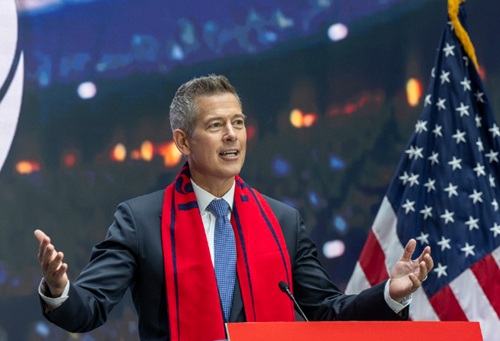
“The new waiver will allow U.S. railroads to complement visual track inspections with innovative technology that will identify issues on our rail before they become a serious safety threat for rail passengers and crew,” said Sean Duffy, secretary of the U.S. Department of Transportation, in a statement.
“Achieving the highest standards of safety is the top priority and this research can help our industry unlock the latest and greatest methods to get American families to their destinations as safely and efficiently as possible,” he noted.
“This waiver will provide the industry with an opportunity to demonstrate the potential of automated track inspection technology to enhance rail safety and improve efficiency,” added David Fink, FRA’s administrator. “ATI technology is designed to enhance already effective visual inspections by catching things that human eyes miss.”
Fink elaborated on the themes of rail safety and efficiency during remarks in late November at the American Association of State Highway and Transportation Officials 2025 Annual Meeting in Salt Lake City.
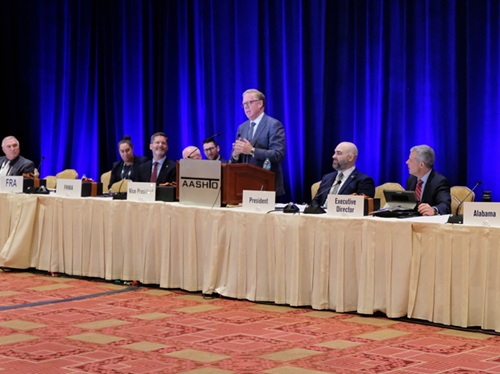
He noted that FRA has two core mandates. “The first is to promote safety in the railroad industry and, second, to support the development of infrastructure that underpins a modern, efficient rail network,” Fink explained. “These goals are not separate. They go hand in hand. However, safety comes first for a reason and it will be my primary focus as FRA administrator. As a result, we are looking at, and encouraging, the use of technology to make our railroad system safer.”
He added that FRA’s safety and efficiency focus is also “all about fixing railroads – small railroads and large railroads alike – and making things safer for our entire nation’s railroad system. We want to work with project partners to find ‘win-wins’ that will improve the safety and efficiency of our nation’s rail network.”
Fink noted that freight railroads are working better now with public transit agencies and with other railroads that are interested in passenger service as well. While there are still issues – such as with insurance and infrastructure – where the “win-wins” are, the railroads are “stepping up,” he stressed.
“We need to deliver projects on time and on budget, and though we’re really struggling with construction [cost] inflation, by working together cooperatively and collaboratively with USDOT and the states, we will certainly see more of that across the country,” Fink said.