


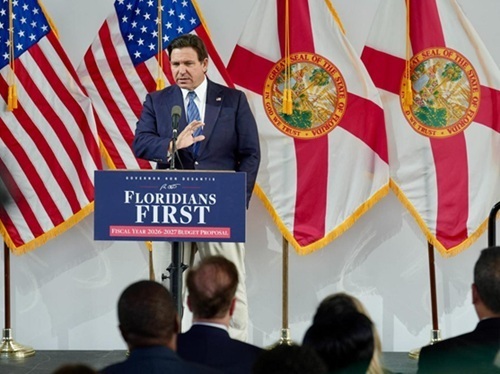
On December 10, Governor Ron DeSantis (R) (above) issued a “Floridians First” state budget proposal for fiscal year 2026-2027 that totals $117.4 billion, including $15.4 billion worth of proposed transportation investments.
[Above photo by the Florida Governor’s Office]
“Governor DeSantis’s budget … invests in critical projects to reduce congestion and increase our state’s economic competitiveness; further demonstrating Florida’s role as the national benchmark in a state-led transportation system,” noted Jared Perdue, secretary of the Florida Department of Transportation, in a statement.
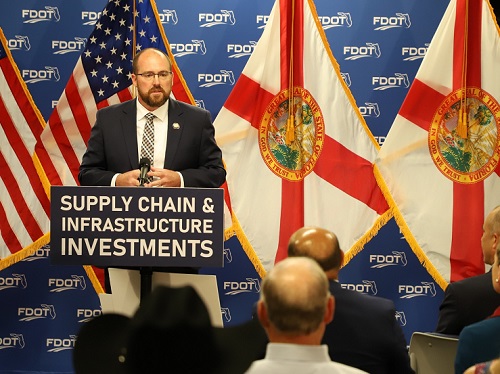
“With these investments, Florida DOT will be further equipped to deliver on our commitment of getting the job done to reduce travel times, increase capacity at our airports, support our growing commercial space industry, and ensure road safety,” he said.
In terms of specific transportation investments, the governor’s budget proposes:
- Allocating $4.9 billion for highway maintenance and construction while adding 181 new lane miles to the state’s roadway network. Earmarking $1.4 billion to resurface 2,622 lane miles and $873 million to repair or replace 59 bridges statewide.
- Issuing $269.2 million to support statewide highway safety projects and initiatives, such as preventing wrong-way driving and lane departure incidents, as well as educational safety campaigns aimed at reducing fatalities or serious injuries resulting from the use of impairing substances.
- Allocating $93.4 million supporting projects in Florida’s Spaceport Improvement Program, which will be further bolstered by additional investments through the International Aerospace Innovation Fund within Space Florida to support increased activity at Cape Canaveral.
- Earmarking $295.5 million to projects that support Florida’s commercial airports and general aviation facilities.
- Issuing $30 million to the Rural Infrastructure Fund to support local rural infrastructure projects such as roads, storm and wastewater systems, and telecommunications facilities.
- Allocating $81.9 million to the Small County Outreach Program to assist small county governments in repairing or rehabilitating county bridges, paving unpaved roads, addressing road-related drainage improvements, resurfacing or reconstructing county roads, and constructing capacity or safety improvements to county roads.
- Earmarking $25.8 million to the Small County Resurfacing Assistance Program to assist small county governments in resurfacing or reconstructing county roads.
- Issuing $69.7 million for the County Incentive Grant Program to provide grants to counties to improve transportation facilities located on the State Highway System or to relieve traffic congestion on the State Highway System.
- Providing $22 million to projects that support the growth and development of Florida’s network of rural airports.
- Issuing $155.5 million to projects that will enhance Florida’s cruise and cargo operations and support the world’s busiest cruise ports, bringing the cumulative investment to $1.2 billion since 2019. Funding is contingent on compliance with state energy policy as well as cooperative engagement with spaceports as directed in state law where such functions overlay.
- Allocating $233.2 million for projects that support Florida’s intermodal freight and rail infrastructure, bringing the cumulative investment to $1.5 billion since 2019.
- Earmarking $19.9 million for projects included in the Aggregate Grant Program, which will increase storage capacity for critical construction material and keep infrastructure projects on track, bringing the cumulative investment to $77.5 million since the program’s inception in 2024.
Other states are also proposing big transportation investments as well.
For example, the California Transportation Commission recently approved $1.1 billion to fund new zero-emission buses, charging stations, and related infrastructure, as well as investments to restore aging bridges, improve highway safety, and increase mobility on local streets.
Guided by the Build More, Faster – For All infrastructure agenda proposed by Governor Gavin Newsom (D), that funding includes
$53 million to purchase 12 clean energy locomotives to replace older models across Southern California’s Metrolink system; roughly $57 million to repair a section of State Route 1 near Lucia damaged by mudslides in 2024; $9.5 million to help build a mobility center in Santa Maria that will serve as a hub for regional clean-energy buses; and $839,000 to construct bike lanes and improve sidewalks on South Avenue in Orange Cove.
“The significant investments made today and throughout the year support Caltrans’ ongoing response to the effects of climate conditions on key assets, increased demand on the transportation system, and our continued efforts to enhance mobility for all users,” noted Dina El-Tawansy, director of the California Department of Transportation, in a statement.
 States
Kansas DOT Helps Host ‘Drive To Zero Day’ Event
March 13, 2026 States
