


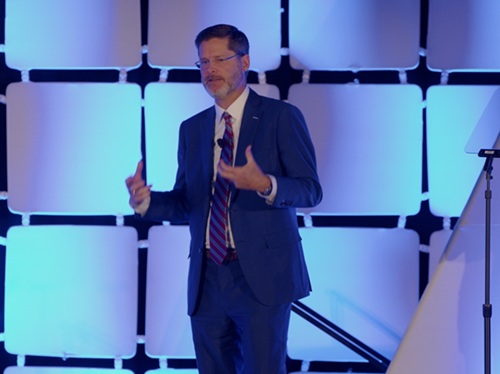
In support of its partnership with state departments of transportation, the Federal Highway Administration recently allocated funds to several new and existing programs to support roadway congestion relief efforts, advance transportation workforce development, and accelerate the adoption of market-ready innovations for the nation’s highway systems.
[Above photo by AASHTO]
Speaking at the 2026 American Association of State Highway and Transportation Officials Annual Meeting in Louisville, KY, Federal Highway Administrator Sean McMaster said those programs are part of a broader effort by his agency to “re-energize people and … our engagement with our state partners, with the right frame of reference. Our job at Federal Highways is to help states administer their programs consistent with the law.”
McMaster noted that FHWA just issued a $100 million notice of funding opportunity for its Congestion Relief Competitive Grant Program; an initiative aimed at “advancing innovative, integrated, and multimodal solutions to highway congestion” in the most congested metropolitan areas of the United States.
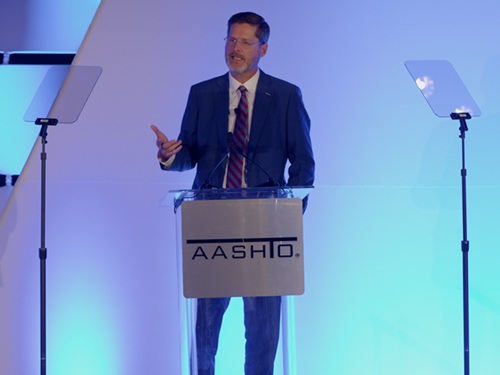
“We want to see congestion relieving projects implemented successfully and quickly,” McMaster said in his remarks. “More will be coming [related to roadway] congestion relief, I have no doubt, but this is the first one out.”
FHWA is also launching a new $26 million program called “Highway WORKS” that McMaster noted will provide up to $500,000 to each state, the District of Columbia, and Puerto Rico to implement workforce development and training opportunities for the next generation of highway transportation workers. That program will complement the agency’s existing workforce development programs in the transportation space, he noted.
“The ‘Highway WORKS’ program is going to streamline and maximize the distribution of our workforce development funding by utilizing a call for statements of work sent directly to state DOTs via the federal highway offices around the country,” he pointed out. “We need a workforce for the future, so we need to keep providing opportunities to attract people to our amazing industry.”
Finally, McMaster said FHWA is formally launching its “STRIDE” program by providing roughly $51 million to support the deployment of “proven, market ready roadway technologies” – and $40.7 million of that investment will go towards “nationally significant highway innovations,” he stressed.
“STRIDE” is short for “State Transportation Roadway Innovation Deployment Excellence” and replaces the agency’s Accelerated Innovation Deployment or AID Demonstration program and State Transportation Innovation Council or STIC Incentive Program. It is designed to support Round 8 of the agency’s Every Day Counts endeavor and other major highway innovations across various project phases.
“In conjunction with our Connected Corridors initiative, all 50 states, the District of Columbia, and Puerto Rico are eligible to receive up to $782,000” from the STRIDE program,” McMaster said. “And, if you add that to the Connected Corridors funding, that means nearly $1 million for every state, the District of Columbia, and Puerto Rico – ensuring direct funding to deploy modern transportation solutions. So this is a really exciting opportunity here.”
McMaster closed his remarks by touching on what he called one of FHWA’s major goals for the next two years: Shortening the environmental review process for major transportation projects.
“We’re talking about reducing how long it takes to move through the process for the largest, most complex transportation projects,” he said. “Environmental assessments and environmental impact statements are really challenging and have been for a very long time.”
Right now, McMaster said the timeline for such statements – from start to finish – has been reduced to an average of 33 months “as of right now, but the goal for my team is to get this down to 24 months.” And his plan for the next two years is to “prioritize it and keep pushing” to reach that two-year completion goal.
“So I’m asking for your help to get this done,” McMaster said at the meeting. “Let’s do this; let’s build these projects and then we’ll have an amazing record of success.”
 Top Stories
New AASHTO Leaders Elected at 2026 Annual Meeting
November 20, 2026 Top Stories
