


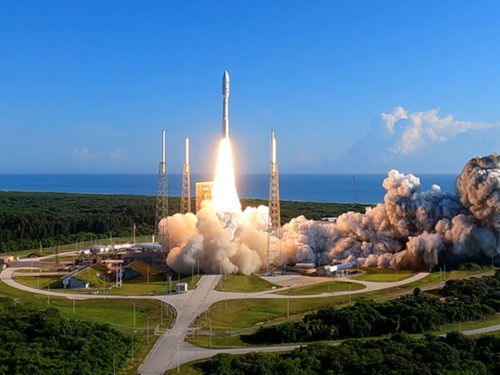
The Federal Aviation Administration recently issued a request for information or RFI to get public and industry feedback on two new initiatives – one regarding the design and location of future spaceports and the other on how it should set aside “priority airspace” for important space-launch routes.
[Above photo by the FAA]
The agency noted that those two new initiatives support President Trump’s Executive Order entitled “Ensuring American Space Superiority” and his 2026 National Space Transportation Policy. Specific feedback is sought regarding four points:
- What makes a good new viable spaceport site. Key factors include safety, geography, access to roads and utilities, ability to launch over open water, limited overflight of other countries, and room for future growth.
- Why some existing commercial spaceports are underused and what the federal government could do to make them more useful.
- The viability of previously-discussed locations for new spaceports, including sites in Florida, Georgia, Puerto Rico, offshore launch platforms, and any other possible locations.
- How “critical space launch corridors” in airspace should work, with the goal of supporting faster, more frequent launches while minimizing disruption to regular air travel and maintaining safety.
The FAA noted that the U.S. was responsible for 217 of the 329 commercial space launches worldwide in 2025 and expects to see that number will soar to 10,000 FAA-licensed launches and re-entries a year by 2035. However, 83 percent of current U.S. space launches come from just three sites: Cape Canaveral Space Force Station and Kennedy Space Center in Florida and Vandenberg Space Force Base in California.
“The United States … can push our edge even further with more space launch infrastructure,” said Ryan McCormack, USDOT undersecretary for policy, in a statement. “To reach 10,000 launches and reentries annually by 2035, we must modernize our approach to spaceports. This RFI is our call to action to industry partners to weigh in with their expertise and help us build a resilient, efficient, and secure foundation for the next great era of American space dominance.”
“Public input is essential as we plan for the future of commercial space transportation,” added Bryan Bedford, FAA administrator. “By hearing from industry, local communities, aviation stakeholders, and the broader public, we can better identify viable spaceport locations and develop airspace routes that support more frequent launches while maintaining the highest standards of safety and efficiency.”
 Nation
Podcast: How MoDOT Cut Wildlife Vehicle Crashes
October 9, 2026 Nation
