


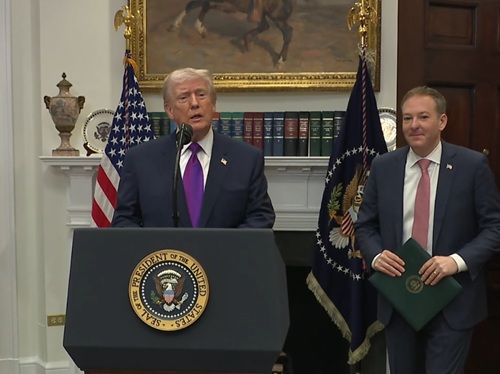
On February 12, the Environmental Protection Agency withdrew the 2009-era greenhouse gas or GHG “endangerment finding” and all subsequent federal GHG emission standards for all vehicles and engines of model years 2012 to 2027 and beyond. The action also eliminates all off-cycle credits, the agency said.
[Above photo via The White House]
Billed as “the single largest deregulatory action in U.S. history,” EPA said its final rule withdrawing that finding should save more than $1.3 trillion by removing the regulatory requirements to measure, report, certify, and comply with federal GHG emission standards for motor vehicles – as well as savings from the repeals of associated GHG compliance programs, credit provisions, and reporting obligations that exist solely to support vehicle GHG regulations.
According to EPA, this action also reduces costs for new vehicles and avoids the costs of purchasing equipment related to electric vehicles, resulting in an estimated average cost savings of over $2,400 per vehicle.
The agency said in a statement this major deregulatory initiative included substantial public input and robust analysis of the law following the U.S. Supreme Court decision in Loper Bright Enterprises v. Raimondo and West Virginia v. EPA.
In finalizing this rule, EPA added that it “carefully considered and reevaluated” the legal foundation of the 2009 endangerment finding and the text of the Clean Air Act or CAA in light of subsequent legal developments and court decisions.
The agency also concluded that Section 202(a) of the CAA does not provide statutory authority for EPA to prescribe motor vehicle and engine emission standards in the manner previously utilized, including for the purpose of addressing global climate change, and therefore has no legal basis for the endangerment finding and resulting regulations.
EPA said it “firmly believes” the 2009 endangerment finding “exceeded the agency’s authority to combat ‘air pollution’ that harms public health and welfare,” and that a policy decision of this magnitude, which carries sweeping economic and policy consequences, lies solely with Congress.
 Top Stories
FRA Deputy Outlines Agency’s Rail Goals for 2026
February 13, 2026 Top Stories
