


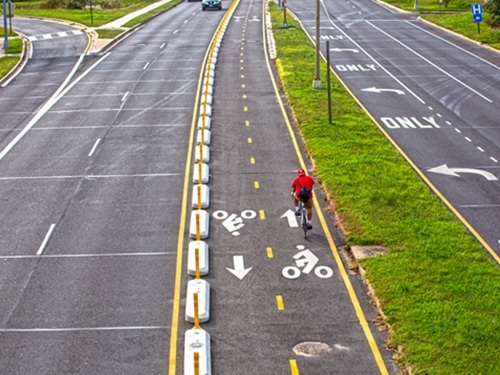
The District Department of Transportation, which serves Washington, D.C., recently launched what it calls the “Cool Corridors” pilot study that aims to reduce extreme heat on the city’s streets, improve neighborhood comfort, and help create a more resilient transportation network for residents.
[Above photo by DDOT]
Via this program, the agency is applying solar reflective “cool pavement” coatings at five sites across the city that have been designated as “urban heat islands,” which can make cities like Washington, D.C., noticeably hotter than surrounding areas – sometimes 10 to 15 degrees hotter than nearby rural areas, especially in neighborhoods with fewer trees and more pavement.

Cool pavements use light colored, solar-reflective coatings that bounce sunlight away instead of absorbing it, lowering surface temperatures by as much as 20 degrees.
Paired with tree canopy and green infrastructure, those pavement treatments are what DDOT describes as “a simple and sustainable way” to make streets and sidewalks more comfortable and welcoming for everyone, while also extending the life of the pavement itself.
“The Cool Corridors pilot reflects our commitment to delivering innovative transportation solutions that improve quality of life for our communities,” explained Sharon Kershbaum, DDOT director, in a statement.
“By testing new technologies alongside long-term investments in the District’s tree canopy and green infrastructure, [we are] creating cooler neighborhoods,” she said.
This pilot project is part of the Cool Corridors Multi-Hazard Resilience Study, which DDOT is leading in partnership with three other city agencies: the Department of Energy and Environment, the Homeland Security and Emergency Management Agency (HSEMA), and the Department of Health.
The project is funded in part through a Federal Emergency Management Agency Building Resilient Infrastructure and Communities or BRIC grant secured by HSEMA, DDOT noted.

 States
