


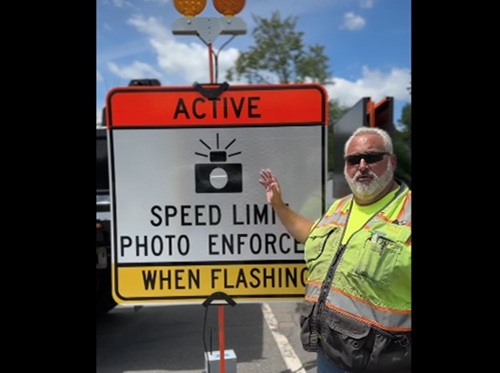
The Connecticut Department of Transportation has deployed automated speed cameras in select highway work zones to deter speeding and improve safety for roadway workers and motorists.
[Above photo by CTDOT]
The agency said its “Know the Zone: Automated Work Zone Speed Control Program” will use radar-based speed cameras to detect vehicles traveling 10 mph or more above the posted speed limit in designated highway work zones and captures images to document potential violations.
The program – which has been in a testing phase since October 2025 – went fully live on June 1 at three locations: I-95 Interchange 43 in West Haven, CT; I-95 Interchange 74 in East Lyme, CT; and Route 2 in Colchester, CT.
CTDOT said those camera systems will initially issue only warning notices for drivers traveling 10 mph or more over the posted work zone speed limit.
Beginning July 6, however, penalties include a written warning for a first offense and a $75 fine for a second violation within one year, while any vehicle traveling 85 mph or more in a work zone will receive a $75 fine – including on a first offense.
The agency added that violations under the program do not result in insurance points or appear as moving violations on a driver’s driving record.
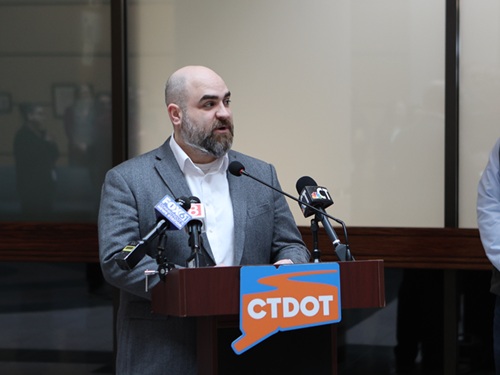
“Work zone speed cameras are a proven tool to slow drivers down and discourage dangerous behavior,” said Garrett Eucalitto, CTDOT commissioner and immediate past president of the American Association of State Highway and Transportation Officials, in a statement.
“Lower speeds in work zones mean safer conditions for roadway crews, fewer crashes, and safer travel for everyone moving through active work zones,” he pointed out. “I hope no one receives a citation because that would mean everyone is doing their part to keep work zones safe.”
[Editor’s note: Other state departments of transportation are either testing or currently using camera technology to improve highway work zone safety, such as the Arkansas Department of Transportation, the Kentucky Transportation Cabinet, and the New York State Department of Transportation.]
CTDOT noted that data collected from March through May during the pilot test of the program indicated that speeding occurs frequently in the state’s highway work zones.
During testing across multiple work zones, speed cameras detected more than 8.4 million vehicles, with approximately 1.36 million vehicles driving above the posted work zone speed limit. Additionally, more than 4,000 drivers were detected traveling over 85 mph, including more than 150 traveling over 100 mph.
The agency noted that signage will be posted in active work zones to notify motorists when automated speed camera enforcement is in use.
All cases are reviewed by the State Police prior to issuance of a ticket, CTDOT stressed, with facial features of motorists digitally masked in images where vehicle occupants are visible.
 States
Oklahoma DOT Begins $408M Bridge Replacement Project
September 18, 2026 States
