


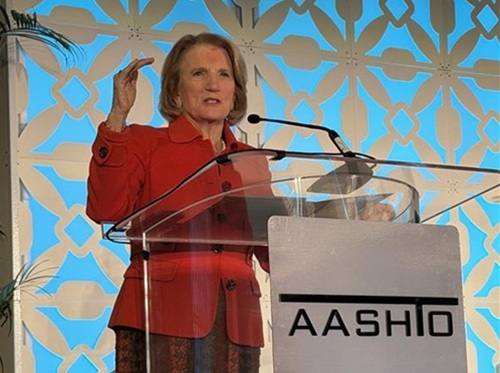
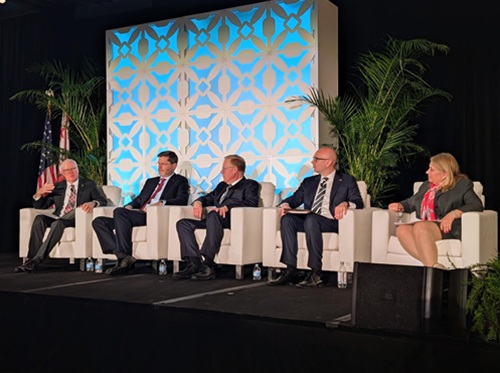
Key leaders from the Senate and House of Representatives shared their thoughts on critical transportation issues Congress aims to tackle in the coming year during the American Association of State Highway and Transportation Officials 2026 Washington Briefing this week at the Westin DC Downtown Hotel in Washington, D.C.
[Above photo by AASHTO]
Sen. Shelley Moore Capito (R-WV), chair of the Senate Committee on Environment and Public Works, emphasized the importance of “safety first on our highways, reforming and modernizing our programs to increase efficiencies, and addressing the variety of transportation issues” as key priorities for Congress as work continues on reauthorizing surface transportation funding for the next several years.
“I am committed to completing it by September 30. That is the goal,” Sen. Capito noted in her remarks regarding reauthorization legislation. “Hopefully, we will get a bill up by spring to start negotiations. We need to make sure we do this right, because it is very long-lasting. It will be a bipartisan bill, which is a good thing, because by having to compromise, it produces a stronger result.”
She also noted that current reauthorization legislation within the Infrastructure Investment and Jobs Act or IIJA created a “proliferation of programs and a lot of discretionary funding.” In the next reauthorization bill, “we want to move that funding back into formula program,” Sen. Capito said.
Sen. Sheldon Whitehouse (D-RI), ranking member on the Senate EPW Committee, joined the session virtually and stressed the need to prepare the transportation system to withstand the impact of extreme weather.
“Transportation is being more and more affected by extreme weather – we see that in Rhode Island where coastal roads are being blocked and flooded out by rain and ocean storms,” he emphasized. “We must make sure that as weather becomes a more significant threat that we are ready for it. Whether that is from flooding rain, ocean sea level rise, or wildfires, the U.S. transportation system needs to be ready for a more extreme and dangerous environment.”
Sen. Whitehouse also reiterated the importance of “non-partisan politics” as reauthorization legislation is developed.
“I think the message needs to be that permitting reform should not pick favorites, highways serve everyone, and that the Army Corps of Engineers has a vital role to support river and coastal infrastructure,” he stressed. “None of that should be affected by partisan politics.”
Rep. Rick Larsen (D-WA), ranking member for the House Transportation and Infrastructure Committee, noted that T&I has received over 11,000 requests from members and stakeholders for the reauthorization bill.
“Specifically, we want to provide at least the same level of current funding [as in the IIJA],” he said. “We are leaning into bipartisan support for transportation to support a strong bill and state DOTs are a valuable resource in that process. We have a lot of work to do but we are working diligently in a bipartisan way to address all of these requests.”
Rep. Sam Graves (R-MO), chair of the House T&I Committee, echoed Rep. Larsen’s bipartisan positioning of the work being done on the reauthorization bill, adding that “this is the most important [reauthorization] bill we’ve ever done because of difference between what we have and what we need is so great. And it will be somewhere near the $550 billion mark.”
Rep. Graves noted that he seeks to make this a very “traditional” bill with “everyone having some buy-in” on this legislation. “I want to see more formula funding going to the states and give the states more autonomy,” he added. “One thing government doesn’t do well is anticipate. So we’re trying to figure out the [transportation] needs of the country for the next 20 years and plan for that. It also means thinking outside the box – providing the ability to make adjustments so we can make better investments for the future.”
 Top Stories
Federal Transportation Leaders Outline Goals
February 25, 2026 Top Stories
