


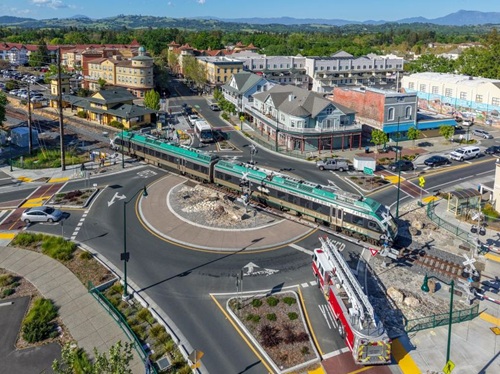
The California Transportation Commission or CTC recently allocated nearly $900 million in state and federal funds to advance mass transit systems, expand pedestrian and bicycle options, and improve freight movement statewide.
[Above image via Caltrans]
That includes $47 million from the federal Infrastructure Investment and Jobs Act or IIJA and $405 million from California Senate Bill 1, known as SB 1 or the Road Repair and Accountability Act of 2017.
California has received an annual investment of approximately $16.7 billion in infrastructure funding since IIJA’s passage, the CTC said. That includes investments to upgrade the state’s roads, bridges, rail, public transit, airports, electric vehicle charging network, ports, and waterways.

The remaining investments are supported by SB 1, which has provided nearly $5.5 billion annually for transportation projects since 2017. SB 1 calls for splitting the money between state and local agencies. Road projects progress through construction phases more quickly based on the availability of funds, including projects that are partially funded by SB 1.
Concurrently, the CTC also approved plans for new investments in California’s transportation infrastructure in the coming years, including approval of the 2026 State Highway Operation and Protection Program or SHOPP that invests $17.9 billion over the next four years in the state highway system for new safety features, more access for bicyclists and pedestrians, and repairs of pavement and bridges.
“These investments modernize transit, strengthen freight and expand safe travel options,” said Toks Omishakin, secretary of the California State Transportation Agency, in a statement. “This reflects a continued hallmark of Governor [Gavin] Newsom’s administration – strengthening and improving critical infrastructure throughout California’s communities.”

“The significant allocations made support a sensible balance between immediate project needs with funding for long-term improvements that continue to shape the future of our transportation system,” added Dina El-Tawansy, director of the California Department of Transportation, known as Caltrans.
“Transportation is ultimately about people – how we get to work, to school and to each other,” said Clarissa Falcon, CTC’s chair. “The investments we’re making improve safety, strengthen mobility, and connect communities across California. The commission is proud to partner with Caltrans and regional agencies to deliver projects that make a real difference in people’s daily lives.”
CTC also highlighted several key projects receiving funds from this allocation:
- The Bay Area and Southern California will receive $273 million to deploy cutting-edge technology to rail systems currently under construction, including an expansive tunnel connecting downtown San Jose to Santa Clara as part of BART’s regional expansion.
- The Port of Long Beach will receive $33 million to expand rail freight operations, strengthening California’s position as the nation’s premier gateway for trade and commerce.
- Los Angeles will receive $35 million to complete the design and construction of rail power infrastructure citywide.
- Sacramento, the state capital of California, will receive $33 million to build a major public-access electric vehicle charging facility on a 118-acre parcel of land.
- San Diego County will receive $3 million for a Del Mar Bluffs stabilization project aimed at protecting eroding coastal bluffs; adding to prior investments to secure critical coastal rail infrastructure from the impacts of climate change.
- Statewide issuance of $1.5 million in seed funding for an automated communications system that tracks moving vehicles to prevent collisions — a next-generation solution modeled on air traffic control technology.
 States
TxDOT Putting New ‘HERO’ Boxes to the Test
March 27, 2026 States
