


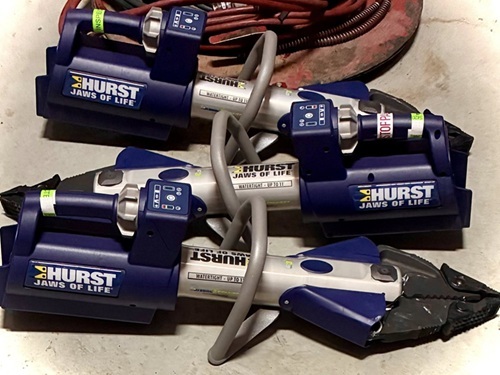
The Alaska Department of Transportation & Public Facilities recently delivered new vehicle extrication tools, known as the “Jaws of Life,” to 14 fire department and Emergency Medical Service (EMS) agencies statewide, supporting faster and safer response to serious motor vehicle crashes on Alaska’s roadways.
[Above photo by Alaska DOT&PF]
This effort is part of the Alaska DOT&PF’s “Partners in Safety” initiative – a comprehensive approach to improving roadway safety that recognizes the critical role first responders play during the most severe crashes.
In Alaska, many crash responses – particularly along high-speed rural highways – are handled by volunteer fire and EMS crews operating with limited resources. Through its EMS Extrication Tools Assistance Project, Alaska DOT&PF said it is using flexible federal funding to make a one-time investment in life-saving equipment that supports emergency response infrastructure.
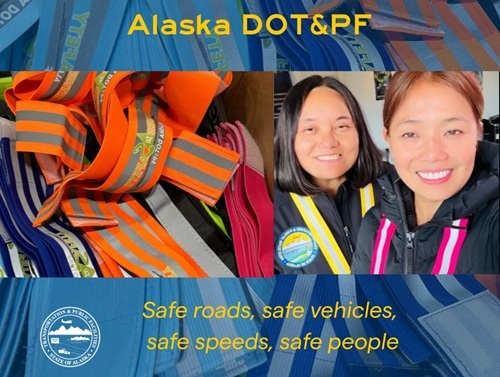
[Editor’s note: In a separate safety initiative, the Alaska DOT&PF formed a new “safety plan” in partnership with the Municipality of Anchorage Plan that secures more than $30 million in funding to advance critical highway safety improvements across Anchorage.]
Most emergency response agencies received extrication tool packages in late 2025, with the remainder expected to be delivered in the early months of 2026.
The impact of this investment is already being seen in the field. A rural volunteer fire department responded to a nighttime motor vehicle crash involving a tractor trailer, where two occupants and their pet were trapped inside their vehicle after it came to rest against trees.
With temperatures near negative 25 degrees Fahrenheit, responders used one of the newly provided extrication tools to clear debris and open a door within minutes – allowing the occupants and their pet to be safely removed and evaluated by medics.
“When serious crashes occur, the first hour of care – often referred to as the ‘golden hour’ – is critical,” explained Ryan Anderson, commissioner of the Alaska DOT&PF, in a statement.
“In Alaska, that care is often delivered by volunteer responders working in remote locations and severe weather,” he added. “This project is about getting the right tools into the hands of responders who are already doing extraordinary work, so they can do their jobs safely and effectively.”
 States
Leadership Change Ahead for Rhode Island DOT
February 6, 2026 States
