


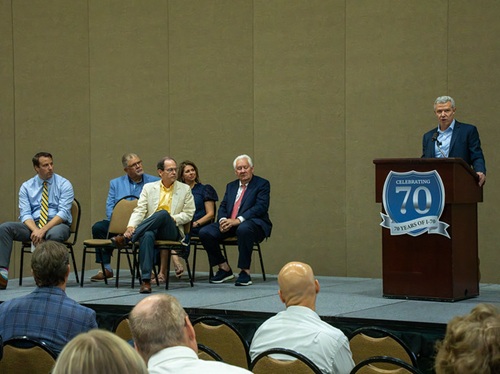
Jim Tymon, executive director of the American Association of State Highway and Transportation Officials, recently spoke at an event in St. Charles, MO, honoring the initial construction of the I-70 highway 70 years ago – stressing how interstates are the “backbone” of the nation’s surface transportation system.
[Above photo by MoDOT]
The Missouri Department of Transportation hosted that event – officially entitled “Celebrating 70 Years of I-70” – on August 14 at the South Exhibit Hall of the St. Charles Convention Center as the initial construction work on I-70 in St. Charles is considered the “birthplace” of the U.S. Interstate Highway System.
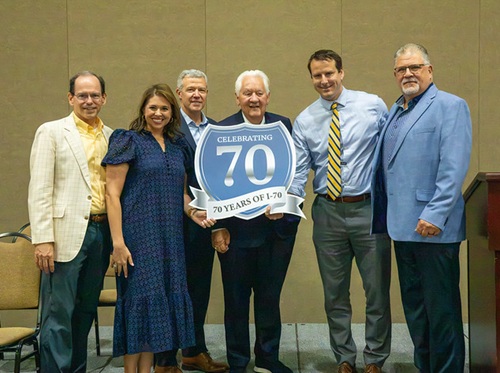
Speakers at the event include AASHTO’s Tymon; Ed Hassinger, MoDOT’s director; Bob Brinkmann, former chairman of the Missouri Highways & Transportation Commission; Michelle Hatway, director of the Missouri Department of Economic Development; Joe Gildehaus, presiding commissioner for Warren County, where St. Charles is located; and Eric Kopinski, director of the “Improve I-70” program for MoDOT.
Construction of a national system of interstate highways was the brainchild of Dwight D. Eisenhower following his election as America’s president in 1952.
When he officially took office in 1953, he carried with him two powerful experiences regarding the importance of building a coast-to-coast highway network.
The first was his participation in a 1919 cross country Army convoy, which took more than two months to travel from Washington, D.C., to San Francisco. The second was his exposure to Germany’s Autobahn network during World War II. Both of those experiences convinced him that the United States needed a modern, high speed, and strategically resilient highway system.
The lessons from those experiences were woven into what eventually became the Federal Aid Highway Act of 1956, which in turn led to the construction of the “Dwight D. Eisenhower National System of Interstate and Defense Highways.”
Tymon referenced the importance of Eisenhower’s early roadway experiences in the creation of the IHS during his presidency.
“It took Eisenhower’s convoy 62 days to get from the east coast to San Francisco and difficulty of that journey left an impression on him,” Tymon said. “And as the Supreme Allied Commander in Europe during WWII, he was able to experience a road system that was superior to that of the U.S. at the time. And those experiences helped develop his support for the creation of the Interstate Highway System which he signed into law in 1956.”
He noted that the 70th anniversary of the interstate system also coincides with the 100th anniversary of the partnership between AASHTO, state departments of transportation, and the Federal Highway Administration in planning and designating the network of roads that make up the U.S. Numbered Highway System. “That system – which included Route 66, also celebrating a 100-year anniversary this year – was the foundation for the interstate system we use today,” Tymon said.
He noted that FHWA held a special “Reimagining American Interstates” event earlier this summer to ensure that the interstate system will continue to serve each state and the entire nation for the next century.
“The interstate system allows people and goods to move between states. It drives economic growth. It helps family and friends travel safely to see this great country,” Tymon emphasized, noting that St. Charles serves as a great example as I-70 has allowed it “to become an economic engine for the area and the state. With the Improve I-70 program, Missouri is producing results and the efforts will be felt by future generations to come.”
 Nation
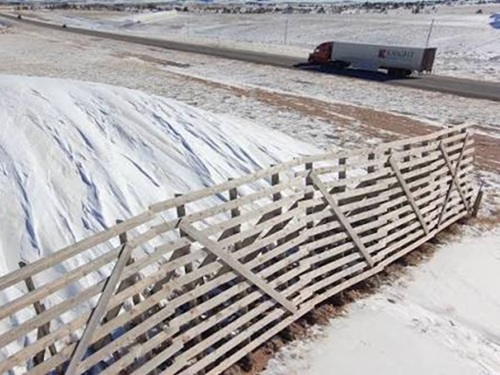
Documentary on Wyoming DOT Snow Fences Wins Emmy
August 21, 2026 Nation
