



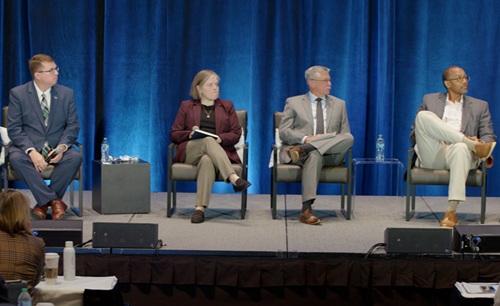
A “fireside chat” at the American Association of State Highway and Transportation Officials 2026 Safety Summit in Hartford, CT, discussed the use of automated speed enforcement technology in highway work zones as a way to improve safety for both highway workers and motorists alike.
[Above photo by AASHTO]
That session – entitled “Fireside Chat on Speed Management Technology” and moderated by Russell McMurry, AASHTO president and commissioner of the Georgia Department of Transportation – featured Cedric Ward, director of the Office of Traffic and Safety within the Maryland State Highway Administration (MDSHA), a division of the Maryland Department of Transportation; Michael Hanson, director of the Minnesota Office of Traffic Safety and chair of the Governor’s Highway Safety Association; Christine Mayeur, associate director of the Multimodal Safety Engineering Division within the District of Columbia Department of Transportation; and Jason Siwula, deputy state highway engineer at the Kentucky Transportation Cabinet.
“Work zone safety is critically important – and the data shows why it’s so important to have automated speed enforcement in work zones,” McMurry said, pointing to data gathered by the U.S. Department of Transportation that an estimated 113,000 work zone crashes occurred in 2024, leading to 41,000 injuries and 850 fatalities – including 285 deaths involving commercial motor vehicles and 156 pedestrian fatalities.
MDSHA’s Ward noted that Maryland “has widely adopted, recognized, and accepted automated speed enforcement or speed safety cameras—so much so that there are carve outs in our law for school zones, residential districts, high injury networks, work zones, institutions of higher education, and other site-specific locations. Basically, the bottom line is that we’re serious about safety and we’re serious about excessive speeding.”
He said recent legislation now allows Maryland to use portable automated speed enforcement camera units. “That was a big win [as it] allowed us to use more than one camera in a work zone.
This allowed us to put multiple cameras in a work zone for better overall coverage,” Ward noted. “Something that’s also just recently started is our vulnerable road user protection law. We were able to get this bill through [the legislature] pretty much without any hiccups. We knew we had support for vulnerable road user initiatives [and] this opens up 135 corridors across the state for speed safety cameras.”
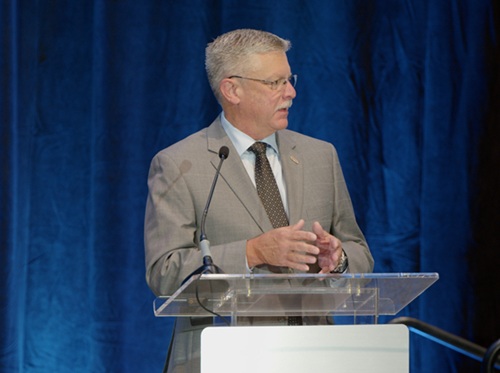
Minnesota’s Hanson noted in his remarks that “speeding is pervasive on every roadway within our country; it’s part of our culture and it’s something that is extremely difficult to overcome.”
For that reason, he said “we have to embrace the technology that exists today, even as it is under attack from many different areas, in many different viewpoints. We have to continue to advocate for this strategy … because speed is what kills people; it’s what injures people; and that’s what we have to prevent. And this is where speed safety cameras come in.”
Hanson stressed that speed enforcement technology is something “we have to learn how to adapt to and, more importantly, learn how to sell it to our policymakers. Because that’s the tough part to overcome. And when we look at all of the fear of technology, we have to figure out better ways to message its benefits and better ways to sell it.”
The District DOT’s Mayeur noted that not only does her agency operate speed enforcement cameras but it oversees a “really robust effort” to keep bus priority lanes and loading zones free of traffic. Called the “clear lanes program,” it is operated in partnership with the Washington Metropolitan Area Transit Authority that operates the transit buses and subway system in Washington, D.C.
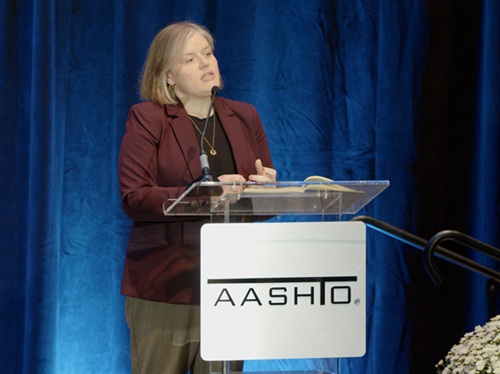
“This is an effort to keep bus lanes and bus stops clear so that people can be safe; so they can get in and out of buses safely and so that buses can run efficiently,” Mayeur noted.
Her agency also operates 56 red light cameras, 32 stop sign cameras, and nine truck restriction cameras. “This is the way we look at these efforts: being proactive about safety,” Mayeur noted. “We do an eligibility engineering assessment for each of those sites and then a camera feasibility site assessment. So we’re not only looking at it from our engineering side, but we’re also looking at it from just the feasibility of installing that camera. And that’s something that’s often missing from automated enforcement systems.”
However, KYTC’s Siwula reiterated in his remarks that there can be a lot public pushback against automated speed enforcement technology which must be accounted for as states explore using it as a way to improve work zone safety.
“We do not have automated enforcement in Kentucky – and the reason is because communication about these things is really, really challenging,” he said. “What we have is camera-assisted speed enforcement or a kind of a hybrid enforcement model. So, when there are workers present within the work zone, a system is allowed to be present and activated. And when that is activated, there has to be a worker in the work zone.”
Siwula explained that what people are concerned about with camera-based speed enforcement systems is publicly identifiable information being published broadly. “That is why this is a complicated and challenging topic,” he stressed. “But the safety need is urgent. And we can’t just wait. We need to use all the tools that we have available to us. And sometimes, you know, there’s an opportunity to get a nontraditional tool deployed to do an important job. It doesn’t matter what state you’re working in; zero [fatalities and injuries] should be our number regardless.”
 Top Stories
AASHTO Safety Summit: Land Use Planning Perspectives
October 9, 2026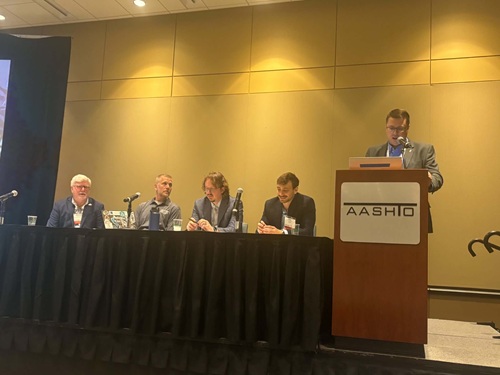 Top Stories
