


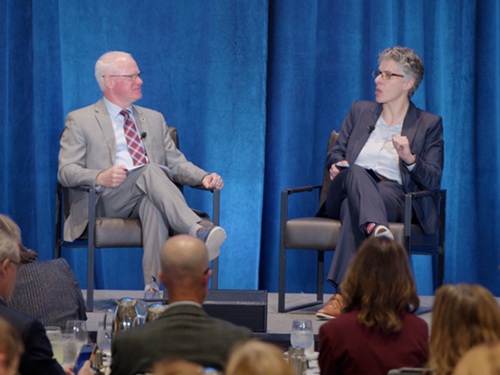
Two separate sessions at the American Association of State Highway and Transportation Officials 2026 Safety Summit and Peer Exchange in Hartford, CT, delved into how a variety of new technologies are gradually filtering into the North American automotive market – enhancing occupant protections while reducing and in some cases eliminating the potential for vehicle crashes.
[Above photo by AASHTO]
Sarah Puro, vice president of safety and technology policy for the Alliance for Automotive Innovation, stressed in a September 27 luncheon keynote speech at the summit that “automakers and their suppliers are safety stakeholders, too, and want to work with the whole safety ecosystem to leverage automotive innovation around common-sense solutions to reduce fatalities and serious injuries on our nation’s roadways.”
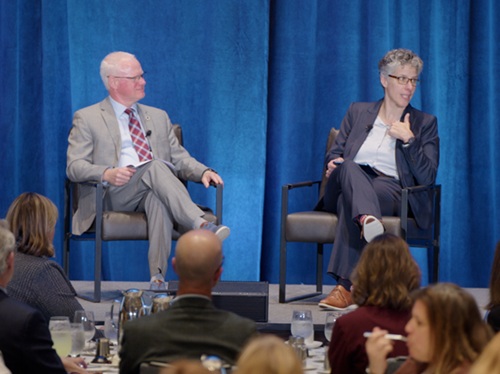
However, when it comes to developing and delivering new automotive safety systems, “it requires a long lead time for the [automotive] industry – between five and six years, if everything goes right, to bring something from concept to a vehicle that you can buy in a dealer showroom,” she said. “In a lot of ways, we are still on the first generation of technologies such as ADAS [Advanced Driver Assistance Systems] so they’re only going to continue to get better.”
Puro noted that vehicles will also increasingly become more automated, which is going to “potentially require some internal cameras to help address things like distraction or what we like to refer to it as ‘driver inattention,’ because there are a lot of things that can keep you inattentive from the road.”
That is all part of an ongoing effort by automakers to keep making major investments in the research, development, and testing of technologies to improve safety of the vehicle, she said.
“They have developed crashworthiness and crash avoidance systems to help improve safety on our roads, and help everyone avoid crashes and save lives,” Puro pointed out. “Lane-keeping assist and blind spot monitoring are things those of you with newer cars actively experience daily, but you probably don’t spend a lot of time thinking about other advances, such as improved crumple zones or better seatbelt pretensioners. They’re there and they help to keep you and your passengers safe.”

Subsequently, Kristina Boardman – secretary of the Wisconsin Department of Transportation and chair of the AASHTO Committee on Safety – explained during a September 29 session she moderated that developing vehicles with a greater ability to keep people safe “is all about the shared system approach. Everyone is connected – the automakers, the government regulators, and the states. And we as state departments of transportation need to do our part to have verified [roadway] information that we can give to the automakers to ensure safer vehicle operation.”
During Boardman’s session, three automaker representatives provided an overview of how vehicle technology is helping improve transportation safety – though often not as fast as many of them would like.
“So, when we show all these new technologies are reaching 100 percent application in model year 2025, we’re talking at least a decade before it’s on even the majority of cars on the road,” stressed Schuyler St. Lawrence, principal engineer for Toyota Safety Regulation and Research Department.
“One of the things we have to consider and temper our expectations about is that all these new technologies require a long time to roll out,” he emphasized. “A lot of these technologies aren’t going to be on the cars that are getting in crashes this year. We’re looking at 2040 before a lot of these are commonplace on vehicles. That’s something I think we really need to keep in mind; as we operate our broad transportation system, it takes time for these technologies to roll out, as exciting as they are to me personally.”

Edward Thai, senior regulatory safety engineer for the Hyundai America Technical Center, added another wrinkle where automated driving systems are concerned: developing “digital rules of the road” so automated systems operate vehicles in line with the way humans use the same roadway – whether as pedestrians, bicyclists, or as drivers in other vehicles.
“People underestimate the breadth variation and the impact of all these traffic rules,” he stressed. “You have federal rules, state rules, and then local jurisdictions as well. And when you kind of add this all up, it’s about 90,000 jurisdictions. So it is not an easy problem to solve.”
Another misconception is that, “well, the traffic code is out there, all you have to do is follow it literally and rigidly – but there are exceptions, such as, what if intersections are blocked off and you have to make a U-turn? So, we’re in the process of taking all of these rules and really translating them and putting them in a database for automated vehicles to access,” Thai said.
Yet the value proposition to developing more automated driving systems continues to become more positive as time – and technological development – goes on, argued Shelly Chaka, executive director of General Motor’s Safety Assurance for Effective Autonomous Driving Software or SAFE-ADS department.
“There is an extremely high value opportunity for roadways that are informational and have machine readable, timely, accurate information,” she explained. “And so the ability to standardize these roads and have digital feeds that give information around work zones, speed limits, whether there is construction, all of these things that we talk about. They will be manifested not just for AVs [automated vehicles], but even for human drivers. It is really important that we think about how we have data feeds that are standardized across different states.”
Chaka having a closer connection between roads and vehicle from a data perspective will also create significant shifts in the how vehicles are perceived in the future.
“When we look at AV technology, it will become less about being getting you from point A to point B but becoming more like your phone – a companion – that is going to do more for you,” she said. “It will be about how the vehicle helps you complete all of your daily tasks.”
 Top Stories
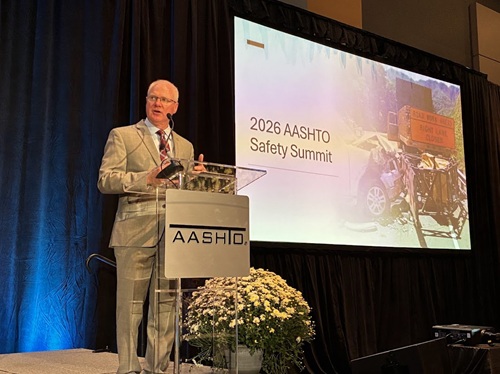
AASHTO Safety Summit: Safety as a ‘Core Design Element’
October 2, 2026 Top Stories
