


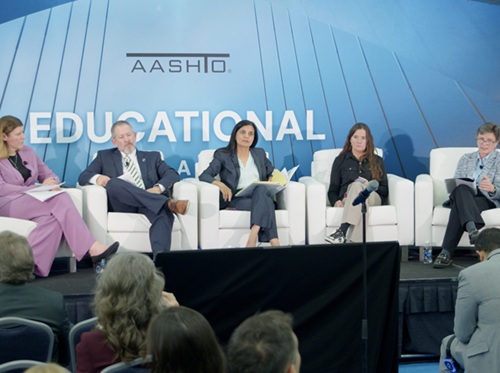
At the American Association of State Highway and Transportation Officials 2026 Annual Meeting in Louisville, KY, a knowledge session examined how state departments of transportation successfully deliver complex mega-projects that benefit communities in collaboration with private sector partners.
[Above photo by AASHTO]
Victoria Sheehan, highways and roads market sector director at HDR – the session’s sponsor – moderated a panel discussion that featured Julie Meredith, secretary of the Washington State Department of Transportation; Priya Jain, commissioner of the New Jersey Department of Transportation; Carmen Swanwick, director of project development for the Utah Department of Transportation; and Brad Reynolds, Carolina Crossroads project director for the South Carolina Department of Transportation.

The panelists explored how state DOTs and their private-sector partners can work together to lead coordinated corridor programs and deliver complex mega projects – using real-world experiences to highlight key decisions, proven strategies, and leadership practices that support safe, efficient, and innovative transportation solutions.
Drawing on her nearly 25 years of mega project experience, WSDOT’s Meredith highlighted a massive effort to strengthen transportation infrastructure in Washington State: the $5.69 billion SR 520 Bridge Replacement Program. Spanning six miles between the Bellevue area and I-5 in Seattle, the project addresses seismic resilience, multimodal needs and corridor reliability through a design-build model, which is a project delivery method where one team is responsible for both designing and constructing a project under a single contract.
“This project improved safety,” she explained. “We addressed wind-wave action, earthquake vulnerabilities and reliability; added multimodal options, including the future possibility of light rail across the project; and addressed environmental concerns.”
A subset of that bridge replacement program, WSDOT’s State Route 520 Montlake Lid and Bridges project, recently won the People’s Choice Award in the 2026 America’s Transportation Awards competition.
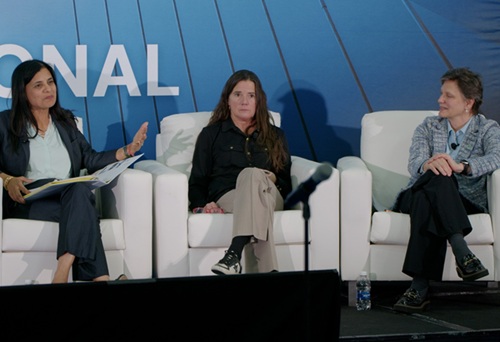
That $487 million project improved safety and mobility in an earthquake-prone area by replacing a vulnerable structure near three fault lines with an earthquake-resilient bridge and adding a three-acre landscaped lid, transit facilities, bicycle and pedestrian connections, and high occupancy vehicle or HOV lanes.
It also brought together several major stakeholders, including private sector companies, local agencies, tribes, and community members. “There were 17 neighborhoods, eight legislative districts, seven tribes and several governors that we got to work with,” said Meredith.
“The thing that I learned most about this program and the biggest takeaway were the connections we made with the tribes, who were the first people there. I take that with me today,” she noted.
New Jersey DOT’s Jain offered another perspective on delivering complex projects, showcasing how her agency is handling mega projects through real-world examples and lessons learned.
Highlighting several major initiatives throughout the state, including the Direct Connection Program, Pulaski Skyway, Wittpenn Bridge and Newark Bay Bridge, Jain discussed how the projects are helping keep people and goods moving while modernizing aging infrastructure, easing congestion and improving safety.
“At the end of the day, when we look at what our role is, when I look at all our agencies, it’s about making sure that our goods and our people move safely,” said Jain. “We are helping economic development. That’s the lifeline of our economy – making sure that infrastructure eases congestion while improving safety.”
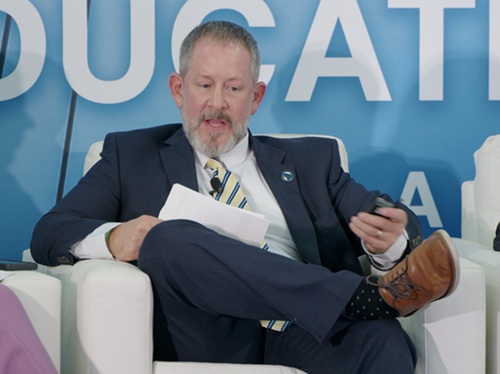
She also emphasized the importance of ownership, responsibility and risk management when public- and private-sector partners work together to deliver projects.
“Our job on the public owner side is to make sure projects get done … [and] my belief is the owner still owns the risk,” Jain stressed. “At the end of the day, we work with our partners, but we are making the decisions that will minimize the risk. I look at mega project delivery as more of an organizational capability.”
Utah DOT’s Swanwick highlighted the West Davis Corridor project, discussing how the 16-mile freeway was critical to supporting rapid development and growth in the area between the Great Salt Lake and the Wasatch Front.
“Due to growth, there was projected to be a 65 percent increase in travel delay. Through our analysis, we found that putting in this new corridor would reduce that delay by 32 percent,” she noted. “There were five local interchanges, 40 structures, 13 miles of new shared path, and 800 acres of mitigation area.”
Choosing a design-build model, the $800 million project was streamlined for success – with 80 percent of the project state funded and the other 20 percent federally funded.
SCDOT’s Reynolds showcased how a different delivery strategy helped transform the Carolina Crossroads mega project into a “phased program” for the agency.
“Originally, we were looking at doing the entire program as one major project or one mega project,” he said. “We determined that we needed to look at a different way of delivering as a program. We split the project up and wanted to make sure that we were still getting interim improvements. It was the feedback that we got from the construction industry that helped shape and direct us in our initial phase.”
The Carolina Crossroads project was originally planned in five phases. In 2024, SCDOT re-phased the project: Phase 3 was divided into subphases, while Phases 4 and 5 were combined into one effort. As the effort progressed, Reynolds highlighted the importance of risk management for a project of this scope.
“This is a very important infrastructure project for the state of South Carolina. It includes a lot of impacts to our traveling public and our freight mobility in and around the area,” he explained. “Risk management for a project like this is key, and that’s something we’ve been working on and dealing with the entire project development process.”
 Nation
State DOTs Detail Speed Management Strategies for Safety
November 20, 2026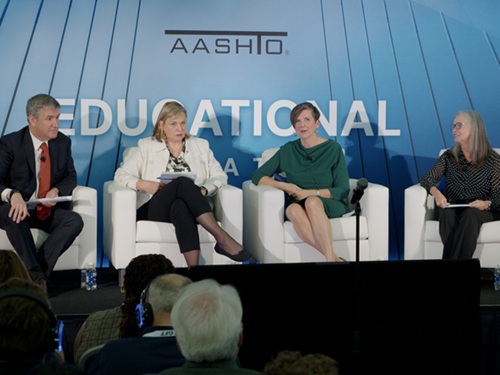 Nation
