


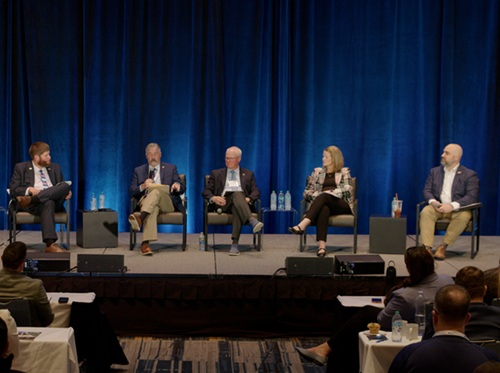
A session at the American Association of State Highway and Transportation Officials 2026 Safety Summit in Hartford, CT, in September focused on ways to improve protection for state department of transportation workers while on the job – especially those laboring in roadway work zones.
[Above photo by AASHTO]
Jordan Striff, employee program safety manager for the Wyoming Department of Transportation, moderated that session, entitled “Championing Employee Safety Throughout the Organization.” It examined how state DOT leaders are critical to setting employee safety priorities and influencing culture changes, with session panelists exploring strategies for supporting employee mental health as well as for leveraging technology and research to ensure better on-the-job protections for employees.
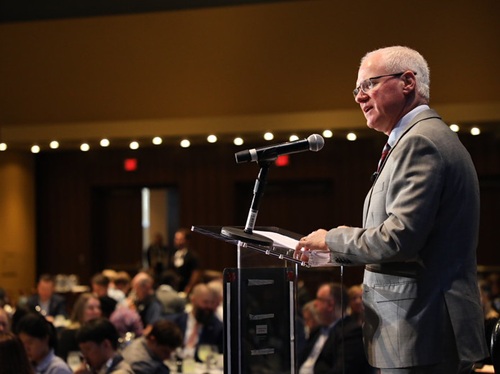
The session featured a host of speakers, including: Russell McMurry, AASHTO president and commissioner for the Georgia Department of Transportation; Garrett Eucalitto, immediate past AASHTO president and commissioner of the Connecticut Department of Transportation; Becky Allmeroth, chief safety and operations officer for the Missouri Department of Transportation; and Scott Taylor, district engineer for the Wyoming DOT.
Wyoming DOT’s Striff also serves as president of the North American Association of Transportation Safety and Health Officials or NAATSHO; a non-profit organization that strives to reduce injuries and incidents that cause injuries among transportation sector employees.
He noted that NAATSHO renewed a memorandum of understanding or MOU with AASHTO in early 2026 because “our groups are converging on the same mission,” namely, that by protecting employees, they also protect the traveling public, and vice versa.
“Because, as public servants, our primary goal is to provide a safe and effective transportation system,” Striff said. “To do that, we have to make sure our customers are taken care of, but without our employees out there doing the job daily and protecting those individuals traveling our highway transportation system, we’re going to fail.”
Georgia DOT’s McMurry stressed that improving employee protections is part of generating an overall shift in the safety culture within state DOTs.
“Safety culture has to continually evolve,” he said. “I don’t know that anybody could ever declare a victory, that we’ve got the perfect culture established, because there’s always something to continue to improve upon and reflect on.”
That is why making safety a priority, especially where employee safety is concerned, represents a key safety culture cornerstone, McMurry noted.
“I always say, ‘I want you to throw the flag.’ If something does not feel safe, I stress that anybody can throw the flag and say, ‘I don’t feel comfortable; there’s got to be a safer way to do this,’” he emphasized. “I am trying to empower people to do that, that they know that they can throw that flag if it’s not safe or if they feel we need to do something a different way.”
That also means involving state DOT leadership more intimately with safety issues on a more frequent basis – something MoDOT put into practice during the COVID-19 pandemic, noted Allmeroth.
“We were just coming out of the pandemic, and at the time we had a pandemic response team comprised of about 120 leaders across our organization from every one of our divisions,” she explained. “We said, ‘Can we shift that focus to a safety response team?’ And so we’ve now had that safety response team going on three years now and it gives us the ability to have every single division leader and every single district leader working together on the same page on common safety goals.”
MoDOT’s safety team structure also speaks to what Wyoming DOT’s Taylor considers another critical aspect of building a better safety culture: leadership availability.
“Some of you probably have heard it before, but the best ability is availability,” he pointed out. “We’ve got to be able to go back and forth between headquarters and the field; to give our employees the confidence, like Russell [McMurry] said, throw the flag. It’s how we are able to break down silos so that safety isn’t a concept isolated in just the safety offices, but actively owned by engineering, maintenance, and operation leadership.”
Taylor stressed that an effective safety culture isn’t one designed to catch people doing something bad all the time. “We definitely need to catch people doing something good way more often,” he said. “That has helped all our programs and morale; our employees have noticed that and a positive, optimistic outlook on safety is mostly what’s been doing that.”
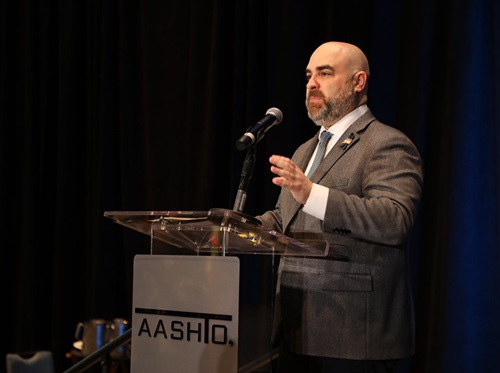
Connecticut DOT’s Eucalitto also stressed that improving employee protection also means ensuring their families are protected as well.
“If your agency hasn’t had a line of duty death, recently, in the past decade or so, it’s important to go back and look at your state statutes and laws as to what is in place for providing for the surviving beneficiaries of that family,” he explained.
“When our colleague Andrew [DiDomenico] was killed two years ago, we hadn’t had a fatality in 12 years,” he added. “And there were a lot of loopholes in the state laws tied to what benefits people get. So, we worked to change some of those laws. That is an example of some of the things that we had not even thought of when it comes to employee protection.”
 Nation
Podcast: How Data Aids Transportation Accessibility
November 13, 2026 Nation
