


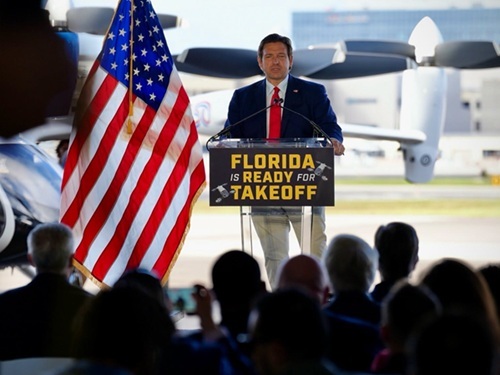
The Florida Department of Transportation recently hosted the first in a series of Advanced Air Mobility or AAM flight demonstrations in Tampa Bay to showcase the capability of electric vertical takeoff and landing or eVTOL aircraft; planes many now often refer to as “flying cars” due to their potential for widespread individual use.
[Above photo by the Florida Governor’s Office]
The agency said that the Tampa Bay demonstration event is part of the Federal Aviation Administration’s eVTOL and AAM integration pilot program or eIPP, which is comprised of a series of demonstration flights across the country aimed at transforming the movement of people and goods – especially in air corridors located above heavily traveled roadways.
That flight demonstration event is one of many planned for Florida DOT’s “Future of Flight” series, which serves as a key fact-finding mission for the FAA as they develop the regulations, infrastructure, and operating procedures that are necessary to safely deploy flying cars for commercial use.
Florida’s eIPP flights, including those in the “Future of Flight” series, involve eVTOL aircraft makers such as Joby Aviation and BETA Technologies, as well as many academia partners, local municipalities, and airports around the state. Those test flights aim to collect data in key focus areas such as noise, airspace integration, and more that will help guide important decisions about this emerging new mode of transportation at the national level.
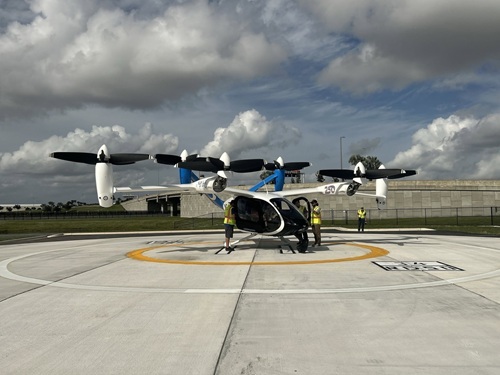
[Editor’s note: Florida DOT, Orlando International Airport, and Joby also recently tested one of the first dedicated “Vertipads” at a commercial airport in the U.S.; a specialized takeoff and landing area for AAM aircraft.]
“Florida has long been a launchpad for new ideas that shape the future of transportation. I’m proud that Florida is a place where groundbreaking transportation technologies can be developed and deployed,” noted Governor Ron DeSantis (R) in a statement. “Thanks to strategic investments, education partnerships, and policies that promote innovation, we’re ensuring that Florida continues to lead the way in aviation and aerospace.”
“More than 100 years ago, Florida helped launch the commercial aviation industry, and now Florida is paving the way for the future of flying cars,” added Jared Perdue, Florida DOT secretary. “The work we are doing will revolutionize the way people and goods move around the state, and this flight series will serve as an important step forward in our efforts to take highways to the sky.”
He added that the Tampa Bay flight demonstrations are among the first to utilize Florida’s Aerial Highway Network, a first-of-its-kind system that creates “highways in the sky” by establishing dedicated aerial corridors that connect major hubs throughout the state. Following along the I-4 corridor, the most heavily traveled corridor in Florida, the “Future of Flight” series will offer real-world demonstrations on how AAM can bypass roadway congestion and completely revolutionize the travel experience for Florida’s residents and visitors in this part of the state.
“Florida has the routes, the operators, and the infrastructure this industry needs to scale,” noted Kyle Clark, founder and CEO of BETA Technologies. “Earlier this year, we flew high-cadence operations along the I-4 corridor with Republic Airways, up to nine legs a day, with energy costs under $17 per leg. Our ALIA aircraft was built to move people and goods faster, more reliably, and at a fraction of the cost of conventional aircraft.”
“Florida is leading the way in embracing electric air taxis and the opportunities they will create for residents and visitors alike,” emphasized JoeBen Bevirt, founder and CEO of Joby Aviation. “It’s exciting to see the state turn that ambition into action, and we’re proud to work with Florida DOT as we plan to fly our aircraft across the state, from Tampa Bay and Orlando to the Space Coast. These flights will give communities a firsthand look at how quiet, electric vertical flight can transform everyday travel.”
 States
FHWA Issues $10.5M in Relief for Colorado Flooding
November 6, 2026 States
