


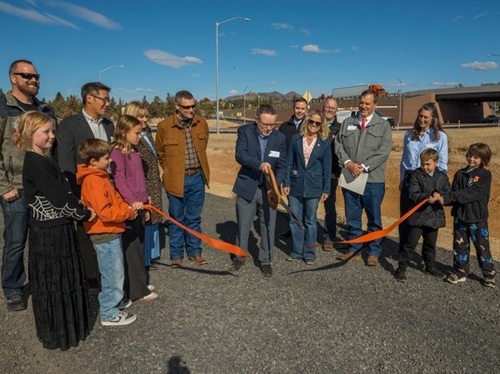
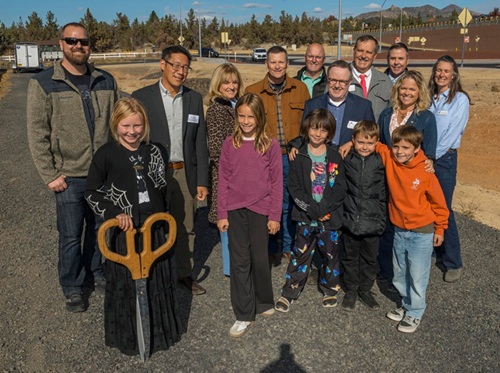
The Oregon Department of Transportation recently hosted a ribbon cutting ceremony to celebrate the completion of safety improvements on U.S. 97 through the City of Terrebonne.
[Above photo by Oregon DOT]
The $39 million project brings significant changes to how people travel through Terrebonne, the agency noted, including a new interchange at Lower Bridge Way, improved pedestrian and bicycle connections, and safety features designed to make it easier for people to navigate the busy U.S. 97 corridor.
The project’s funding includes $20 million awarded through Oregon’s 2017 transportation package – House Bill 2017 – and a $10 million contribution from Deschutes County, the agency said.
Students and families from the nearby Terrebonne Community School joined the ribbon-cutting ceremony to celebrate the new multi-use paths, with students sharing artwork inspired by the question, “What do safe roads mean to me?”
The new connections make it safer and easier for children, families and other community members to walk, bike or roll between the school, surrounding neighborhoods and other destinations in Terrebonne, Oregon DOT said.
For drivers, the agency noted that this project addresses another longstanding challenge: getting on and off U.S. 97 safely. As traffic volumes have grown in central Oregon, Oregon DOT said accessing the highway from local roads and crossing highway traffic have become increasingly difficult.
Now, the new interchange eliminates the need for drivers to make left turns across highway traffic at Lower Bridge Way, providing a safer and more efficient way to enter and exit U.S. 97 without waiting for gaps in traffic, noted Bill Martin, Oregon DOT’s construction and project manager.
“This project is about more than a new interchange. It’s about helping people move safely through their community, whether they’re driving to work, walking to school or traveling through central Oregon,” he explained in a statement. “It’s also an example of what we can accomplish when state and local partners work together to address transportation needs.”
 States
Hawaii DOT Helps Celebrate Aloha Tower’s 100th Year
October 23, 2026 States
