


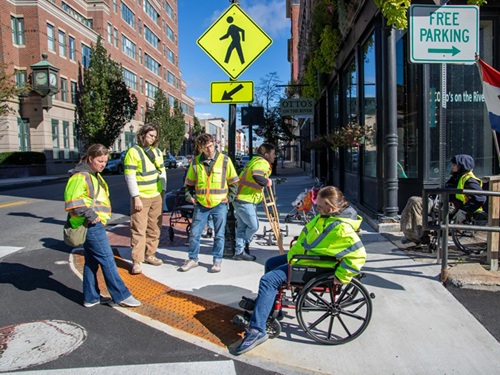
On October 6, the Maine Department of Transportation partnered with WTS, the Maine Department of Labor (MDOL), and nonprofit providers Iris Network and Alpha One to host a hands-on Americans with Disabilities Act or ADA accessibility and training event in Augusta, ME.
[Above photo by Maine DOT]
The event brought together transportation planners, engineers, and other professionals from Maine DOT and WTS – an international organization dedicated to shaping the future of transportation for the public good through the global advancement of women – to conduct a range of “learning activities.” Those activities aimed to deepen participants’ understanding of how people with disabilities and people using mobility devices experience streets, sidewalks, crossings, and other elements of the transportation system, Maine DOT noted.
Participants worked in small groups at two locations: downtown Augusta and the area surrounding the State House along Capitol and State streets. At each location, groups rotated through outdoor sessions led by accessibility experts and people with firsthand knowledge of the barriers that can arise in the built environment.
“Safe, accessible transportation depends on understanding the experience of every person who uses it,” said Dakota Hewlett, active transportation planner with Maine DOT, in a statement. “This partnership gave those who participated an opportunity to see our transportation network from different perspectives and to carry those lessons into planning, design, construction, and maintenance decisions.”
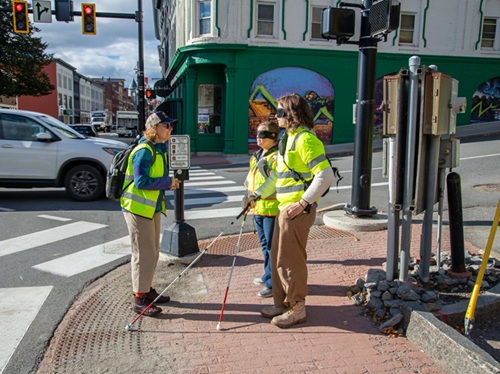
One set of sessions focused on the experiences of people with low vision or blindness. Mobility specialists from the MDOL’s Division for the Blind and Visually Impaired as well as an orientation and mobility specialist from the Iris Network – a Portland, ME-based nonprofit that helps people with blindness or visual impairment attain independence – guided participants through pedestrian environments using white canes and goggles that simulated different types of vision impairments.
The activities highlighted challenges that people may encounter when navigating sidewalks, curb ramps, crossings, signals, surface conditions, and other pedestrian features, noted Emily Becker, vice president of the WTS Maine chapter.
“As transportation professionals, it’s our responsibility to understand that accessibility is about much more than meeting design standards. It’s about creating a transportation system that people of all abilities can safely and independently navigate,” she said. “This hands-on experience gave participants an opportunity to better understand the real-world barriers that people with disabilities encounter every day.”
Other sessions were hosted by representatives from Alpha One – a nonprofit that helps the disabled and aging adults to live independently in their homes and communities – and the MDOL’s Bureau of Rehabilitation Services.
Participants used a variety of mobility devices – such as wheelchairs, knee scooters, crutches, and umbrella strollers – to experience how physical features of the transportation system can affect mobility, safety, and independence.
The use of a range of devices also underscored that accessible transportation benefits a broad range of users, including people with disabilities, older adults, people recovering from injuries, caregivers, and families traveling with young children.
“This training reflected the value of bringing transportation professionals together with disability advocates, mobility specialists, and people with lived experience,” said Theresa Savoy, ADA transportation coordinator for the Maine DOT. “By learning directly from accessibility experts and experiencing real-world conditions, participants can better recognize barriers and help create transportation systems that work for everyone.”
 States
Michigan DOT Issues $65M to Support Transit Projects
October 16, 2026 States
