


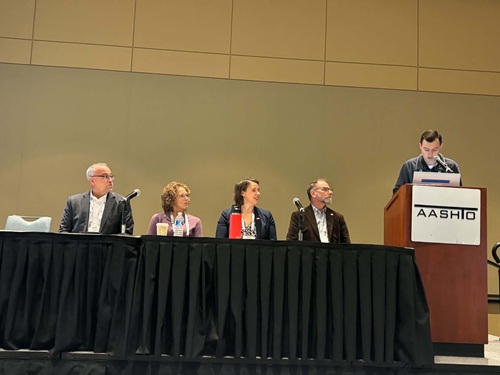
A session at the American Association of State Highway and Transportation Officials 2026 Safety Summit in Hartford, CT, discussed how the “Safe System” approach is reshaping transportation agency culture and helping agencies prioritize roadway safety in every aspect of their work.
[Above photo by AASHTO]
Entitled “Delivering a Safe System,” the session featured a panel discussion, an interactive audience conversation, and a brief roundtable focused on the use of all-way stop signs.
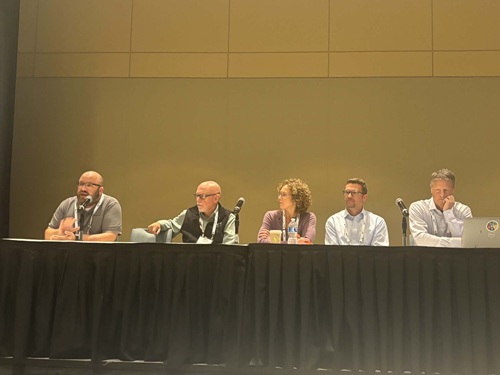
Moderated by Jeremy Thompson, safety engineer at the Ohio Department of Transportation, the panel discussion featured Angie Byrne, safety project lead at Toole Design Group; Mark Carlino, engineering administrator for the Connecticut Department of Transportation; and Ken Johnson, assistant state traffic engineer for the Minnesota Department of Transportation.
Toole’s Byrne emphasized the importance of change management, noting that successful adoption of the Safe System approach must be driven by leadership and making shifts in the organization’s culture.
“This transition is radical and if you don’t feel uncomfortable, you are not doing it right,” she said. “In terms of safe systems, changing the questions, changes the culture.”
Carlino shined a spotlight on the Connecticut DOT’s use of context classification – a system that categorizes roadways regarding its surrounding land use and activity levels to inform roadway design and operating speeds on how residents and visitors use the area.
Through this approach, Connecticut DOT identified locations where vehicle speeds were substantially higher than the posted speed limit. The analysis helped pinpoint areas for targeted safety improvements and determine whether roadways were operating at the appropriate speeds.
“We want this to be a proactive effort and take advantage of the opportunities we have offered,” Carlino said. “This approach will focus on what the needs are for the surrounding communities. Our goal is to cluster the type of similar efforts for counter measures whether that be road diets, refuge islands, land extensions or more.”
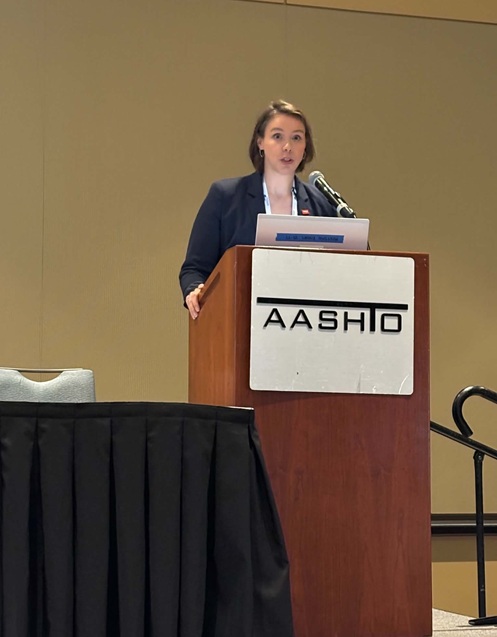
Building on that theme, Johnson emphasized how MnDOT embeds the Safe System approach throughout its organization – playing a major role in planning transportation projects throughout the state and crafting a culture where safety is everyone’s responsibility.
By weaving in this new plan with its complete streets program, active transportation initiatives, and corridor planning processes, MnDOT strengthened safety considerations across projects. This effort helped project managers incorporate safety considerations at all stages of a project – from early planning and scoping to final design and implementation.
“We learned by doing as we developed a plan and implemented it,” Johnson noted. “By spreading the responsibility, we are spreading the acceptance.”
Following the panel discussion, Mary Harding, director of the Highway Safety Bureau at the New York State Department of Transportation, led a conversation on safety performance metrics by posing the question: “How do we measure safety?”
While noting that agencies can build safer roads and encourage the use of safer vehicles, Harding emphasized that improving safety also requires road users to do their part, stressing that “we need people to share the road.”
With a goal of zero deaths on the nation’s roadways, audience members shared best practices in their states as well as their efforts to incorporate a Safe System approach in their agencies.
The session wrapped up with a discussion on all-way stops – an intersection in which every approach is controlled by stop signs, ensuring drivers from every direction make complete stops.
Moderated by Brian Sorenson, the state traffic engineer at MnDOT, the discussion featured Brian Murphy, the traffic safety systems engineer at North Carolina Department of Transportation; Scott Neidert, the traffic safety engineering manager at the Delaware Department of Transportation; and William Lambert, the state highway safety administrator at the New Hampshire Department of Transportation.
Key highlights from the discussion included:
- The NCDOT has implemented over 600 all-way stops since 2019. Recent data shows that 348 intersections indicate significant crash reductions with all-way stops.
- The Delaware DOT currently has 75 all-way stops installed. There has been a drastic reduction in fatal and serious injuries with “fatalities almost eliminated” at these all-way stops, Neidert noted.
- The New Hampshire DOT is using all-way stops as a core effort in their safety program after learning about how states, especially North Carolina and Delaware, used them to successfully reduce fatalities. Since beginning all-way stop implementation, New Hampshire DOT said it witnessed a “massive” safety improvement, with Lambert noting that the agency “didn’t get any more phone calls from locations with all way-stops, which is why we have to push out and advocate that this method is successful.”
Highlighting the real-world benefits of the all-way stop safety measure, MnDOT’s Sorenson noted that the results speak for themselves. “We can prove with data that this is saving lives,” he pointed out.
 Top Stories
AASHTO Safety Summit: Managing Speed with Technology
October 9, 2026 Top Stories
