


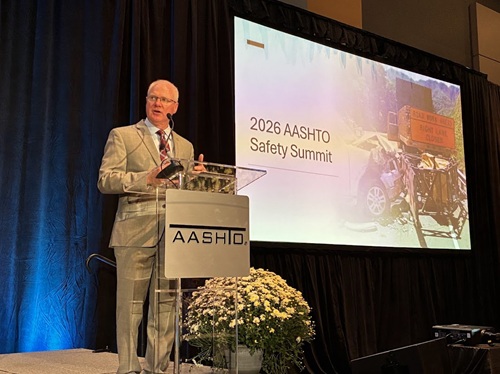
The three-day American Association of State Highway and Transportation Officials 2026 Safety Summit and Peer Exchange – held in Hartford, CT, September 28-30 – gathered together federal, state, and local stakeholders to collaborate on ways to make safety an ever-integral element of the nation’s transportation systems.
[Above photo by AASHTO]
“We continue to broaden the tent to bring more and more people together to work on improving safety outcomes, for we are all in this together when it comes to safety,” explained Russell McMurry, AASHTO president and commissioner of the Georgia Department of Transportation, in his opening remarks at the summit.
“What we need to think about is, with the insights technology and data give us today at our fingertips, how can we use them to accelerate improvements in safety? Because better data equals better insights, better judgement, and better results,” he stressed. “Because, when it comes to safety, let us all be accused of trying.”
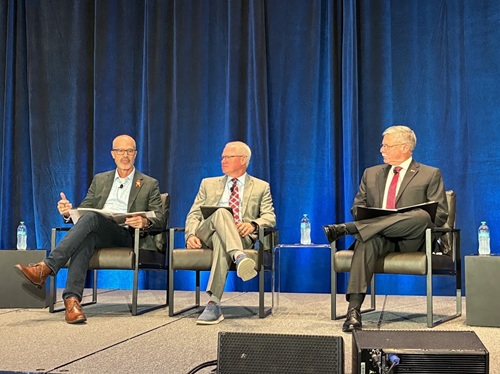
Marc Williams, AASHTO vice president and executive director of the Texas Department of Transportation, added that one reason for the strong focus by AASHTO on reauthorizing federal surface transportation funding this year is that it those funds support a broad swath of safety improvements.
“[Reauthorization] is essential not only for supporting the resources we need for safety improvements but to also provide the guidance and framework for those improvements,” he explained. “While it is a little bit of a downer we have not gotten there yet on reauthorization, from a safety standpoint, we’re seeing significant progress. For example, we’ve seen a significant reduction in [roadway] fatalities over the last two years – we’ve made extraordinary strides, as they are almost down to pre-COVID levels. We are making great steps forward.”
Robert Ritter, associate administrator for safety at the Federal Highway Administration, emphasized that state DOTs are critical to improving safety across the nation’s transportation systems.
“You are the ones working on the fronts lines of transportation, making the hard calls, keeping the public safe every day,” he said. “We are seeing promising shifts in the numbers as injuries and fatalities are declining – that progress reflects hard work being done by you. But let’s be clear: losing 36,000-plus lives on our roads in 2025 is not acceptable. That is why ‘Vision Zero’ is the moral mandate of our profession.”
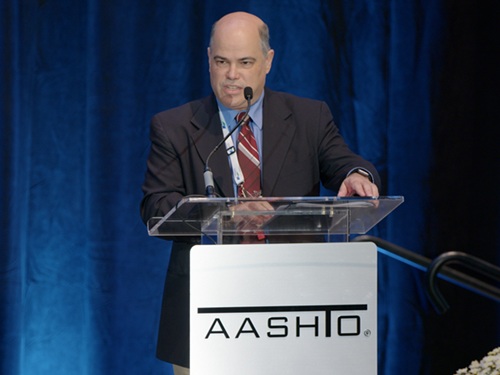
Ritter stressed that, to truly lower fatal crashes, “safety cannot be a stand-alone effort or afterthought: it must be a core design requirement – that is the cultural shift Commissioner McMurry is talking about and why data is critical to making good safety decisions and investments.”
Michael Hanson, director of the Minnesota Office of Traffic Safety and chair of the Governors Highway Safety Association, noted that what is really needed to solve persistent safety issues on U.S. roads is a “holistic approach,” one where there is “more freedom and flexibility to work with anybody” to improve safety across the nation’s transportation system.
“Safety is not a partisan issue,” he stressed. “We are standing on the foreground on next iteration of safety innovation, and it is going to require a lot more flexibility. We need to look at using predictive analytics to create a different picture for our safety goals and work across disciplines to achieve them.”
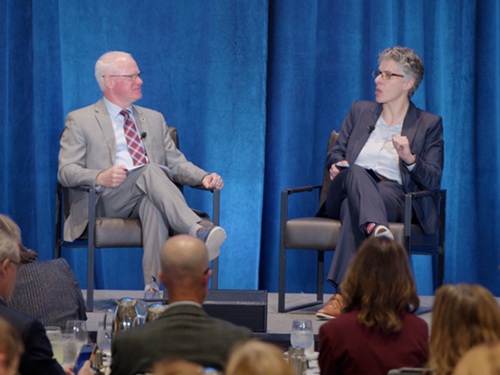
During an “Organizational Safety Culture” session held at the summit on September 30, moderator Garrett Eucalitto – immediate past AASHTO president and commissioner of the Connecticut Department of Transportation – delved into the ways state DOTs ensure safety continues to be a core organizational focus even as leadership and staff change over time.
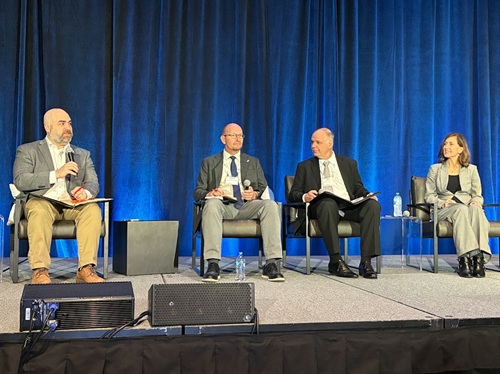
“We need to stress that every project we work on addresses some form of safety,” he said. For example, “projects that reduce traffic congestion also help reduce fender benders and secondary crashes – reducing the potential for fatalities and injuries while saving time and cost for families.”
Calvin Reed, secretary of the Kansas Department of Transportation, noted that states are always faced with “unending needs but limited resources,” which is why taking advantage of the growing availability of data is so important.
“We need to make sure we are targeting our resources to where they are needed the most – that is why data is so important,” he said. “That data helps us identify and target places where we can make a real difference in employee safety and roadway safety; places where we can make meaningful change.”
That includes a focus of the state DOT workforce as well, noted Nancy Daubenberger, commissioner of the Minnesota Department of Transportation. “When we think about building a safety culture, the people at the grassroots level – the boots on the ground – are really key,” she explained. “But it is important to set the tone at the top. We need to make it comfortable for everyone to speak up about issues – especially in terms of after-action reports, where we really learn from events and from one another. We need to be comfortable talking about safety and to reexamine our own safety protocols and risks.”
David Rodrigue, commissioner of the New Hampshire Department of Transportation, added that “it is all about empowering our team to look at this bigger system [and] how we can continuously improve it to make it safer. The bottom line simply is, we bake safety into every single one of our projects.”
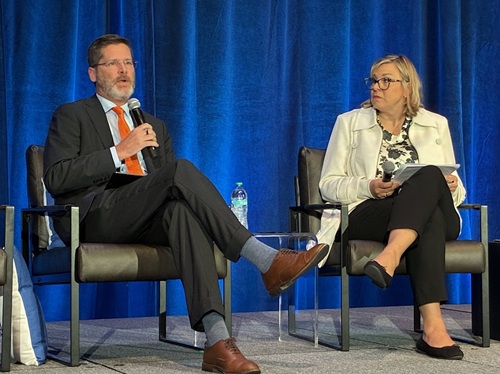
The summit ended with a speech and fireside chat between Sean McMaster, FHWA administrator, and Kristina Boardman, secretary of the Wisconsin Department of Transportation and chair of the AASHTO Committee on Safety.
Boardman noted that the Safety Summit serves as “the ultimate in-person platform for engaging and directing a candid conversation on safety,” helping all the transportation ecosystems participants – federal, state, local, and private sector – find “way to keep moving safety forward.”
In his remarks, McMaster stressed that the transportation community remains “united by single non-negotiable mandate – eliminating fatalities on our nation’s roadways.”
He added that, “while we still have more work to do – we are still losing too many lives in crashes – the critical point is that those numbers are moving in the right direction. That is why, when we examine transportation at the federal level, safety remains the foundation of every federal dollar. We need to keep driving safety forward.”
McMaster stressed that state DOTs “are doing great work and the results are showing” but that there is much more work to do. “My short-term goal is to have another significant decrease in roadway fatalities this year and then see how we can get below 30,000,” McMaster said.
“We should be proud moving needle in right direction – and getting to a sub-30 number would be a huge momentum booster,” he stressed. “You are all doing fantastic work, so keep motivated and stay at it.”
McMaster also believes artificial intelligence or AI can potentially play a big role in helping reduce fatalities as well. “This technology will help us get there, no doubt,” he emphasized. “I am even considering a mid-cycle EDC 9 [a ninth Every Day Counts initiative] for a lot of use cases are already out there using AI,” he noted. “I think the sky is the limit as how use AI to deliver more safety improvements.”
 Top Stories
AASHTO Safety Summit: Boosting Vehicle Safety
October 2, 2026 Top Stories
