


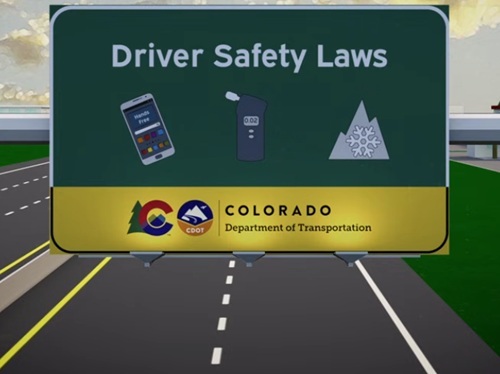
The Colorado Department of Transportation recently released a series of short videos that break down traffic laws commonly misunderstood by motorists – from tire traction requirements to the rules governing vehicles operating around bicyclists.
[Above image by Colorado DOT]
The agency said its “Road Laws” series includes three videos – each focused on a different set of laws – and is available on Colorado DOT’s YouTube channel. The department emphasized that these videos are intended to serve as a simple reference for motorists looking to brush up on the rules of the road.
The first video – Episode 1: Driver Safety – focuses on three relatively new motorist-focused laws:
- Hands-Free Law — As of 2024, it’s illegal to hold your phone — or any electronic device — while driving. This includes making phone calls, texting, emailing and scrolling. Hands-free accessories and phone mounts are permitted.
- Expressed Consent Law — Drivers in Colorado automatically consent to a breath or blood test if suspected of driving under the influence of drugs and/or alcohol. Refusing a test can result in license revocation among other penalties.
- Traction Law — During certain winter weather conditions, drivers must meet traction or chain requirements. These rules help prevent crashes, closures and backups during storms.
In Episode 2: Lane Laws, three motor vehicle operation laws are reviewed:
- Left Lane Is for Passing — Colorado law requires drivers to keep right unless actively passing another vehicle. Driving slowly in the left lane can cause congestion, aggressive driving, and dangerous passing behavior.
- Move Over Law — Drivers must slow down and move over when approaching any stopped vehicle on the side of the road with their hazard lights on; including stopped emergency, maintenance, or tow vehicles. The law is designed to protect first responders, roadside workers, and civilians who are vulnerable to passing traffic. If motorists can’t safely move over, the law requires them to slow down to at least 20 mph below the posted speed limit on highways. On all other roads, slow down to 25 mph or less in a 40 mph zone and at least 20 mph in a 45 mph or higher zone.
- Motorcycle Lane Filtering — Motorcyclists in Colorado are allowed to pass stopped vehicles by slowly traveling between lanes such as when traffic is stopped behind a red signal light. Motorcyclists cannot “lane split,” which involves riding between lanes of moving traffic, which is very dangerous. This video clarifies when lane filtering is legal and what both drivers and motorcyclists should expect to keep everyone safe.
In Episode 3: Bikes, Pedestrians and Intersections, laws regarding active transportation user needs and infrastructure are detailed:
- Passing Cyclists — Drivers must give bicyclists at least three feet of space when passing. When necessary and safe, drivers are allowed to cross a double yellow line to provide adequate clearance. If it is not safe to move over, then drivers must slow down and safely stay behind bicyclists.
- Cyclists & Stop Signs/Red Lights — Cyclists are allowed to treat stop signs as yield signs when the intersection is clear and it is safe to proceed. At red lights, cyclists must come to a complete stop and may proceed only when the intersection is clear.
- Using Crosswalks — Pedestrians should always use crosswalks when crossing the street and avoid crossing mid-block. Drivers are required to yield to pedestrians in crosswalks and use extra caution, especially in low-light conditions when visibility is reduced.
- Roundabout Rules — When large vehicles such as buses or commercial trucks are in a roundabout, other traffic must yield to allow them adequate space. Drivers approaching a roundabout must also yield to traffic already circulating, which comes from the left.
 States
Michigan DOT Issues $65M to Support Transit Projects
October 16, 2026 States
