


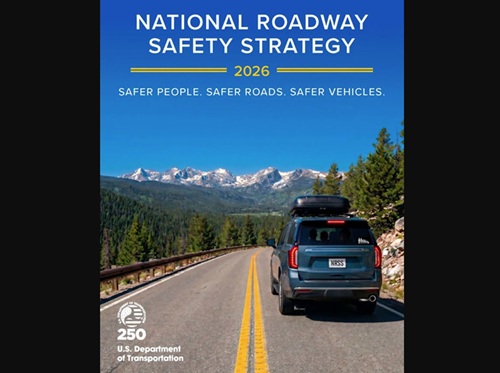
The U.S. Department of Transportation recently introduced a revised National Roadway Safety Strategy or NRSS – an updated interdepartmental plan that aims to reduce both traffic fatalities and injuries on U.S. roadways.
[Above image by USDOT]
The agency said that this updated strategy seeks to make American roads safer for families, truckers, commuters, and construction workers by prioritizing three core objectives:
- Safer People: USDOT is doubling down on safety for families in rural, urban, and tribal communities. That means stronger support for transportation workers and first responders, alongside a renewed commitment to law enforcement.
- Safer Roads: Through more innovative road design, targeted bottleneck relief, and cracking down on dangerous truck drivers, USDOT will keep traffic moving while reducing congestion and improve crash outcomes, including secondary crashes.
- Safer Vehicles: To ensure America stays a leader in vehicle safety, USDOT is modernizing safety standards, advancing a national automated vehicle strategy, and investing in technology to reduce preventable crashes.
“This new strategy doubles down on our coordination with the police, enhancing our anti-congestion initiatives, and embracing automotive innovation to make our streets safer than ever,” noted Sean Duffy, USDOT secretary, in a statement.

“Safety isn’t just a priority, it is the foundation of everything we do,” emphasized Sean McMaster, administrator of the Federal Highway Administration. “Through this reinvigorated National Roadway Safety Strategy, we are engineering safety into the bedrock of America’s roads and targeting action where danger is greatest. Every American deserves to reach their destination safely, and this Administration is using every tool at our disposal to make that a reality.”
“When drivers ignore the rules, operate without proper qualifications, or get behind the wheel impaired, they put all of our lives at risk. Our mission is to strengthen safety, demand accountability, and deliver results that make a real difference,” noted Derek Barrs, administrator of the Federal Motor Carrier Safety Administration. “Working alongside law enforcement and industry partners, I am committed to making bold progress that keeps Americans safer on our roads and our nation moving forward.”
“NHTSA is driving towards its goal of eliminating fatalities on America’s roads,” Jonathan Morrison, administrator of the National Highway Traffic Safety Administration, pointed out.
“Through the National Roadway Safety Strategy and its Safe System Approach, we are focused on creating safer people, roads, and vehicles,” he said. “NHTSA’s ‘Pathways to Safer Streets’ – which leverages tech innovation, law enforcement partnerships, and life-saving prehospital blood transfusions – draws from these strategies and is preventing crashes and saving lives today.”
“Highway-rail grade crossings and rail rights-of-way are where most rail-related casualties occur, and the Federal Railroad Administration is fully committed to supporting safety improvements through our grant programs to prevent injuries, save lives, and keep Americans safe,” said David Fink, FRA administrator.
Paul Roberti, administrator of the Pipeline and Hazardous Materials Safety Administration, stressed that safety focus includes “making sure the 2.3 million hazmat shipments in transit every day are moving safely.”
That also means ensuring transit systems are safe as well, noted Matthew Cahill, acting deputy director for the Federal Transit Administration. “Americans deserve safe, reliable, and modern public transit,” he said. “USDOT is driving innovation forward to upgrade safety systems for operators, elevate the rider experience, and expand accessibility across our nation’s transit networks.”
 Nation
Air Taxi Demonstration Conducted at Texas Airport
September 18, 2026 Nation
