


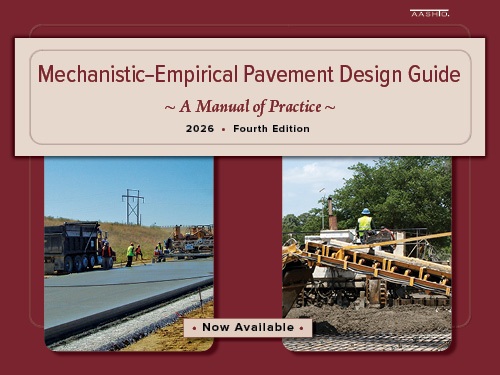
The American Association of State Highway and Transportation Officials recently published the fourth edition of its “Mechanistic–Empirical Pavement Design Guide,” which provides the highway engineering community with a state-of-the-practice manual regarding mechanistic–empirical or ME pavement design methodology.
[Above image by AASHTO]
AASHTO said the manual guides pavement design engineers in making decisions using the AASHTOWare Pavement ME Design software, which includes an updated local calibration guide that replaces the publication, Guide for the Local Calibration of the Mechanistic-Empirical Pavement Design Guide, First Edition, published in 2010.
AASHTOWare, a division of AASHTO, offers a suite of transportation software products delivered through a collaborative business model with state departments of transportation across the country.
AASHTO noted that the fourth edition of its “Mechanistic–Empirical Pavement Design Guide” includes a series of updates, such as:
- Multiple stress creep recovery or MSCR compliance calculated from dynamic modulus data for Input Level 2;
- Integration of the National Cooperative Highway Research Program or NCHRP 1-51 model for slab–underlying layer; interaction into the concrete pavement analysis;
- Design models for an asphalt overlay for rigid, semi-rigid, and flexible pavements, where one or more AC overlays already exists or has been placed;
- Addition of full depth reclamation (FDR), cold in-place recycling (CIR), and hot in-place recycling (HIR) of existing asphalt layers as a rehabilitation design strategy;
- Recalibration of the rigid pavement transfer functions using Modern-Era Retrospective analysis for Research and Applications, Version 2 or “MERRA2” climatic data;
- Inclusion of Level 3 binder grade selection corresponding to the MSCR characterization; and
- Update of AASHTO Material Standards designation numbers.
Also, information from a supplement to the guide’s third edition – originally published in 2020 – concerning the new top-down cracking fatigue model employing Paris’ Law of crack propagation for generating mechanistic responses has been integrated into fourth edition.
To order a copy of the fourth edition of the “Mechanistic–Empirical Pavement Design Guide,” visit the online the AASHTO Store and search by item code MEPDG-4.
 AASHTO
New AASHTO Report Details General Aviation's Impact
September 18, 2026 AASHTO
