


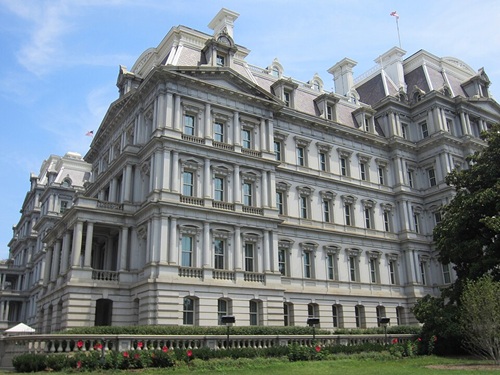
The American Association of State Highway and Transportation Officials recently sent a seven-page letter to the White House Office of Management and Budget offering feedback regarding the federal government-wide proposed rule to update the Uniform Administrative Requirements, Cost Principles, and Audit Requirements for Federal Awards also known as “Uniform Guidance” published in the Federal Register on May 29. Comments to the docket are due July 13.
[Above photo of Old Executive Office Building via Wikipedia]
OMB said its proposed revisions seek to improve transparency, accountability, and oversight for how federal taxpayer dollars are used in the context of federal grantmaking in order to prevent wasteful spending and misuse or mismanagement of federal funds.
“Although federal spending through grants and other types of federal financial assistance has grown exponentially since the initial establishment of OMB’s policies in earlier circulars, corresponding policies capable of ensuring transparency, accountability, and oversight for this increased level of spending remain deficient in the current regulatory text,” the agency said in its regulatory filing.
“As a result, federal financial assistance programs, and the activities performed under federal awards, have not always remained properly aligned with core purposes authorized by law, nor served the needs of the American public as intended,” OMB noted.
While AASHTO stressed in its letter that it supports OMB’s aim to enhance transparency and accountability in the administration of federal financial assistance, the organization made five points:
- Preserve the statutory integrity of formula programs, including the Federal-aid Highway Program;
- Clarify that termination and suspension authority may not be used to cancel, withhold, or recondition apportioned funds absent express statutory authority or specific recipient noncompliance;
- Preserve state DOT flexibility in procurement and project delivery where such flexibility is authorized under federal transportation law and state law;
- Provide clear guidance to federal agencies, recipients, pass-through entities, and subrecipients before implementation; and
- Establish a realistic implementation date that allows federal agencies and recipients to update systems, guidance, agreements, and compliance procedures without disrupting delivery of transportation projects.
“AASHTO especially urges OMB to make clear in the final rule that government-wide financial assistance requirements may not be implemented in a manner that alters, narrows, delays, or conditions the statutory distribution and use of Federal-aid highway formula funds established by Congress,” the organization emphasized in its letter.
“OMB’s regulations should support transparency and accountability within that framework but should not create new administrative conditions that effectively override statutory formula apportionments, restrict eligible project delivery decisions, or introduce uncertainty into funds that Congress has directed to states for the preservation, improvement, and operation of the national transportation system,” AASHTO said.
The association also warned that the proposed rule includes “significant changes that could introduce confusion without further clarification and guidance,” resulting in strained capacity of state departments of transportation to implement timely changes to ensure subrecipients’ compliance.
It could also reduce the willingness of recipients to undertake federally funded projects due to requirements that they accept additional risks and costs, AASHTO added.
“State DOTs are responsible for administering billions of dollars in federal funds to operate and maintain our nation’s multimodal transportation infrastructure, including relying on subrecipients to deliver critical projects on time and on budget in all states and communities,” the organization noted. “As stewards of federal transportation programs, AASHTO’s members express concern that the proposed changes disallowing all costs in certain categories would pose challenges for some recipients and subrecipients in continuing to undertake critical transportation projects and improvements supported by federal financial assistance.”
In addition, AASHTO said OMB’s proposed compliance obligations will require state DOTs to monitor the conduct of subrecipients without necessary flexibility, presenting operational disruption and significant project delivery risk for state DOTs.
 Top Stories
AASHTO Safety Summit: Managing Speed with Technology
October 9, 2026 Top Stories
