


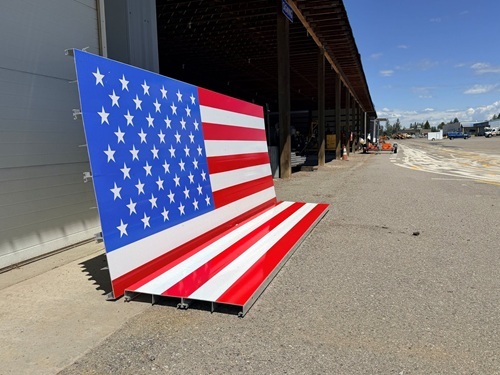
The Idaho Transportation Department recently installed permanent American flag displays on the National Forest Service Rd 164 overpass on I- 90; a stretch of road knows as the “Fourth of July Pass.”
[Above photo by ITD]
The agency said this project is an opportunity to recognize the “unique history” behind one of North Idaho’s most recognizable place names as “Fourth of July Pass” traces its name back to July 4, 1861, when Captain John Mullan and his road-building crew paused atop the summit to celebrate Independence Day while constructing what would become the historic Mullan Road.
Built between 1859 and 1862, Mullan Road was the first engineered wagon route to cross the Rocky Mountains into the Inland Northwest and laid the foundation for transportation corridors that would eventually evolve into modern-day I-90.
More than 160 years later, the pass remains an important gateway connecting communities across North Idaho and the rest of the country, ITD said.
“Fourth of July Pass is one of those uniquely-Idaho places where transportation history and American history intersect,” said Justin Wuest, ITD operations manager, in a statement. “As we approach our nation’s 250th anniversary, it felt fitting to recognize that connection in a visible and lasting way.”
Across the country, state departments of transportation work to install markers recognizing key landmarks, as well as preserve them.
For example, in March, the Colorado Department of Transportation unveiled a series of murals it commissioned to decorate its Firestone-Longmont Mobility Hub – art designed to help “create a connection” with the communities the facility serves along a northern stretch of the I-25 corridor.
Additionally, in September 2025, the Maryland Department of Transportation recently unveiled a new and updated roadside historical marker honoring Civil War-era abolitionist Harriet Tubman and her contributions to American history.
And in October 2023, the Iowa Department of Transportation opened one of its newest “next generation” highway rest areas, which also doubles as a museum of Native American culture.
The agency said at the time that – inside and outside of the rest area – it installed interpretive plaques, statues, and murals commissioned by four Native American artists describe the history of the Native American tribes that resided in the region.
 States
