


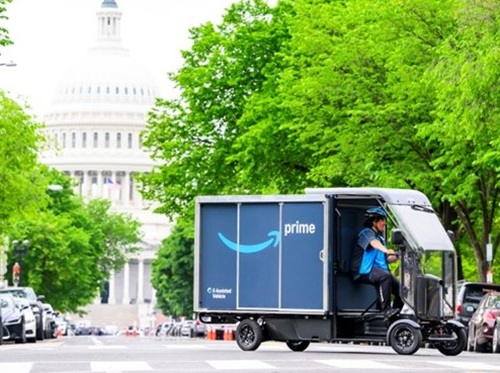
The District of Columbia’s Department of Transportation (DDOT) in partnership with Amazon has launched a new pilot project to support e-cargo bike package delivery in Washington, D.C.
[Above photo by DDOT]
During the 10-month pilot, Delivery Service Partners or DSPs will deliver Amazon packages to customers in Washington, D.C., using a fleet of up to 15 battery-powered e-cargo bikes equipped with a secure rear cargo hold, along with covered seating, a windshield, and windshield wipers, providing weather protection for DSP delivery associates, noted DDOT.
All e-cargo bikes are limited to a 15-mph maximum speed and restricted from traveling on sidewalks, the agency added.
The results of the pilot will be used to inform additional efforts to reduce impacts from last-mile delivery and future operational parameters for e-cargo bikes as needed, noted Sharon Kershbaum, DDOT’s director.

“By using e-cargo bikes to deliver packages, the District demonstrates a commitment to reducing traffic and piloting innovative delivery solutions,” she said in a statement. “DDOT is excited to collaborate with Amazon to adapt to a changing urban freight landscape.”
Located on a secure surface parking lot in southwestern Washington, D.C., Amazon’s “microhub” will provide package storage and a loading zone to support DSP deployment of e-cargo bikes for deliveries to nearby District neighborhoods.
Amazon said e-cargo bikes are a “compelling solution” for urban areas, where deliveries are located closer together. By shifting last-mile deliveries from larger vehicles to e-cargo bikes that can use daylighting and commercial loading zones while also operating in bike lanes, packages can be delivered more efficiently while helping reduce traffic and noise.
“We’ve seen the benefits e-cargo bikes bring to urban deliveries around the world, and we’re excited to launch this pilot alongside DDOT to help ensure we get it right here in DC,” said Dave Alperson, Amazon’s vice president of North America last-mile transportation.
“We’ll continue working alongside community partners in the National Capital Region who understand the local needs best – combining their insights with our expertise in delivery, technology, and innovation to make a real difference in people’s everyday lives,” he said.
DDOT said this pilot program builds on earlier efforts and investments from the Transportation Planning Board (TPB) and the Carbon Neutral Cities Alliance and its 2023 Delivery Microhub Feasibility Report, developed with technical assistance from Nelson/Nygaard through the TPB’s Transportation Land-Use Connections program.
Grant funding from the Carbon Neutral Cities Alliance is supporting Nelson/Nygaard’s monitoring and evaluation of the 10-month pilot for DDOT. Monthly data collection and assessment, including the number of trips to the microhub, route distances traveled by e-cargo bikes, and the number of packages delivered, will help DDOT identify further opportunities for safe and more efficient deliveries across Washington, D.C.
 States
Nebraska Highlights New State Infrastructure Initiative
September 11, 2026 States
