


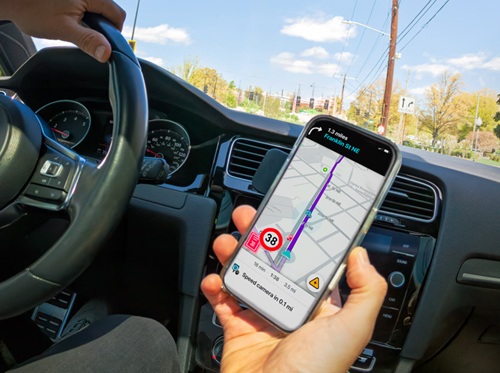
A new study from the Insurance Institute for Highway Safety found that motorists are more likely to use their phones while speeding, a tendency that increases crash risk by combining two dangerous behaviors.
[Above image via IIHS]
Excluding time spent stopped at intersections, mired in traffic, and driving small neighborhood streets, the amount that drivers handled their phones increased the more they exceeded the speed limit, according to a nationwide analysis of cellphone data.
On limited-access roads, according to analysis by IIHS, the share of driving time spent handling a phone rose by 12 percent for every 5 mph drivers went over the local speed limit.

On other roads, such as arterials and routes that connect towns, every 5 mph over the local limit was linked to a smaller 3 percent increase in phone handling – roads often have traffic lights, intersections, roundabouts and stop signs that require drivers to take action periodically, even when traffic is flowing.
The largest increases in phone use occurred on roads with higher posted limits, IIHS said. On limited-access roads with 70 mph limits, for example, for every 5 mph a vehicle exceeded the limit there was a 9 percent larger increase in phone handling than on similar roads with 55 mph limits.
A similar pattern showed up on roads with more access than freeways, IIHS added. Compared with roads posted at 25 or 30 mph, there was a 3 percent larger increase in phone handling for every 5 mph drivers exceeded the limit on 45 or 50 mph roads and a 7 percent larger increase on 55 mph roads.
“Until now, safety experts believed drivers used their cellphones most at slower speeds,” said David Harkey, IIHS president, in a statement. “But data from insurance companies’ safe-driving apps show that, in free-flowing traffic, the opposite is true.”
“It’s alarming that the relationship between cellphone manipulation and speeding was the strongest on roads with the highest speed limits,” added Ian Reagan, the IIHS senior research scientist who wrote the study.
Reagan said several factors could be driving the pattern. One possibility is that drivers who take more risks are both more likely to speed and more likely to use their phones. Another is stress, he noted, as previously research indicated that phone use spikes during rush hour and school drop-off – situations that may also lead people to speed.
Drivers may also respond to other road cues, such as lighter traffic, an absence of pedestrians, or longer gaps between stoplights, IIHS said.
 Nation
FAA Issues $481M to Help Improve Airport Infrastructure
September 11, 2026 Nation
