



The American Association of State Highway and Transportation Officials recently hosted a knowledge session at its 2026 Spring Meeting in Savannah, GA, regarding technological and policy efforts aimed at improving transportation safety.
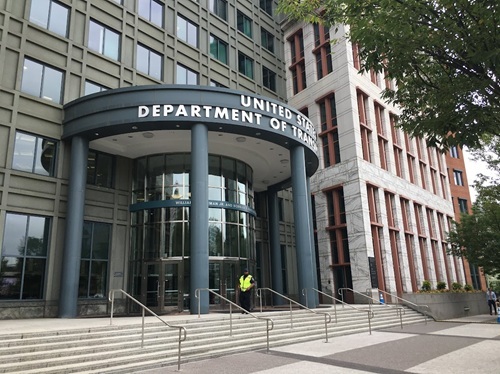
[Above photo by AASHTO]
Kim Kolody, global principal for road safety at Jacobs – the session’s presenter – moderated a panel discussion that featured Sondra Rosenberg, deputy director of planning and administration for the Nevada Department of Transportation; William Pines, administrator of the Maryland Department of Transportation’s State Highway Administration; Kristina Boardman, secretary of the Wisconsin Department of Transportation; and Nancy Daubenberger, commissioner of the Minnesota Department of Transportation.

“Safety is and should be our top priority,” noted Nevada DOT’s Rosenberg. “The numbers we’re seeing [traffic fatalities and injuries] are trending in right direction. But we have more to do.”
She stressed that data will play a major role going forward in helping identify specific issues to help keep reducing traffic fatalities and injuries.
“One example is red light running,” Rosenberg said. “Without data, we would not know how big a problem it has become. And sharing that data will help us and our safety partners work on ways to address that problem [red light running]. There is a lot of data out there – and we’re using AI [artificial intelligence] to analyze it.”
Maryland DOT’s Pines noted that leveraging road condition data, for example, can expand the “safety envelope” and help reduce the impact crashes have on the transportation system.

“Such data helps improve digital highway sign messaging timeliness, with automation reducing that communication timeline from minutes to seconds,” he said. “That is information that can impact secondary crashes; getting drivers to slow down before they reach a crash site. Such data is also a blessing for highway work zones and so many other things.”
Another technology tactic tracks “hot spots” for hard braking events at specific intersections. “That data alerted us to one intersection when a stop sign was obscured by vegetation,” he said. “This is how we use AI to turn data into quality information.”
Wisconsin DOT’s Boardman noted that a similar data-gathering system is helping her agency track wrong-way driving incidences.
“We are noticing that [wrong-way driving] happening more,” she noted. “Are there commonalities with what other states are seeing? That’s where data will help us better align our strategies.”
MnDOT’s Daubenberger, added that the ability to crowdsource data across the transportation system is also helping validate other safety initiatives as well.
For example, she noted that such crowdsourced data confirmed that highway work zone speed cameras reduced the number motorists driving 10 miles per hour over the speed limit dropped by 30 percent, with the number driving 20 mph over the speed limit dropping by 75 percent.
“That data shows that we are changing behaviors,” Daubenberger said.
 Top Stories
AASHTO Comments on 'Corridors of Commerce’ Program
September 18, 2026 Top Stories
