


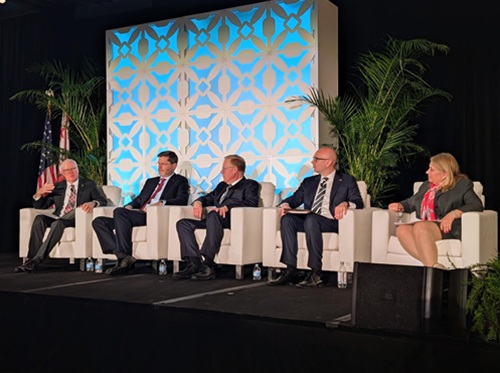
At the American Association of State Highway and Transportation Officials 2026 Washington Briefing in Washington, D.C., modal leaders and a research advisor within the U.S. Department of Transportation outlined key goals for 2026.
[Above photo by AASHTO]
Sean McMaster – administrator of the Federal Highway Administration – stressed that streamlining regulations to accelerate project delivery remains a major focus going forward for his agency.
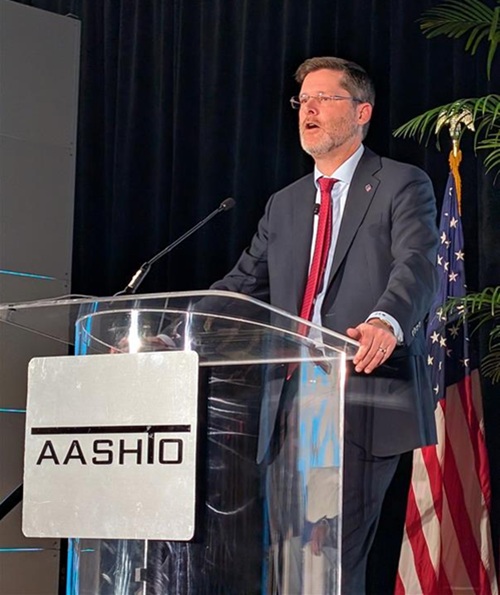
“We are working on ways to cut red tape and accelerate project delivery. And we are succeeding because AASHTO, state DOTs, and FHWA share many core values around improving safety and speeding up project delivery,” he said. “We are succeeding because we are working together.”
He noted that such collaboration is key to delivering the benefits of transportation at a much faster pace. “We’re not talking about weeks or months; we’re talking about years of progress for the American taxpayer,” McMaster said.
David Fink, administrator of the Federal Railroad Administration, echoed a similar theme in his remarks.
“We need to modernize regulations and build a business-friendly environment while holding safety as our highest value,” he said. “The administration is clear – it should not take years or decades to advance rail projects. And, although freight is high priority, we cannot forget the needs of passenger travel.”
Jonathan Morrison, administrator of the National Highway Traffic Safety Administration, said improving roadway safety remains critical for his agency. Yet he also noted that as driver behavior remains a key factor in roadway crashes, NHTSA will be focused on addressing that issue through enforcement and technology initiatives.
“About 50 percent of our [roadway] fatalities involve not wearing seatbelts; 30 percent involved the use of alcohol and drugs; and 30 percent involve excessive speed. Those are shockingly high numbers,” he stressed. “If we can’t convince people to drive more responsibly on the road, we will never achieve our safety goals.”
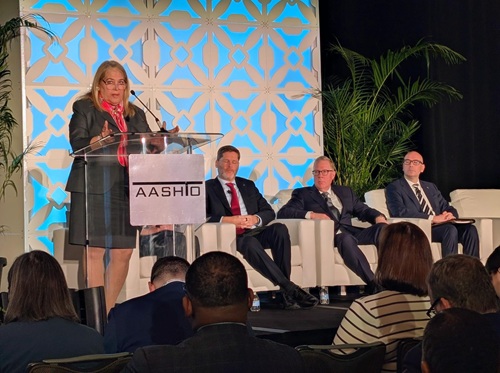
That’s why, going forward, a “central pillar” of NHTSA’s behavioral safety program is law enforcement. “We cannot achieve safety goals without it,” Morrison said.
NHTSA will also enhance that enforcement effort by expanding the reach of education campaigns, trying to save more lives after crashes, and generate higher use of vehicle safety technologies.
“One of our goals is to increase the number of new vehicles equipped with the latest safety technology – and that starts with making them affordable,” Morrison said. “Automated driving also offers incredible possibilities for the future, with its potential to address so many behavioral issues. But let’s be real – this technology is not perfect. But we are not going shy away on encouraging it – the promise of this technology is far too great to ignore.”
Seval Oz, senior advisor within the USDOT’s Office of the Assistant Secretary for Research and Technology, reinforced Morrison’s points on the value technology can deliver going forward in the transportation space.
“We have innovation pockets pretty much across the entire U.S. But, for example, if a truck cannot drive autonomously from coast to coast because of digital changes when they cross state lines, that is an issue,” she stressed. “That is where the federal government comes in; not to tell you [the states] how to innovate, but to help move through harmonization.”
Oz said USDOT is focused on “three huge pillars” where technology can bring significant, positive change to transportation.
“The first is automated corridors for freight; a force multiplier for the American worker,” she noted. “The second is we should be able to predict crashes by analyzing risk factors prior to crashes occurring. That is what AI [artificial intelligence] is giving us.”
But those first two pillars rely exclusively on the third one: real-time data. “Data is king – it makes the feedback cycle work,” Oz said. “Without data, there is no AI, there is no automation. Data will also be useless if it gets stuck in silos and within state lines.”
 Top Stories
AASHTO Safety Summit: Safety as a ‘Core Design Element’
October 2, 2026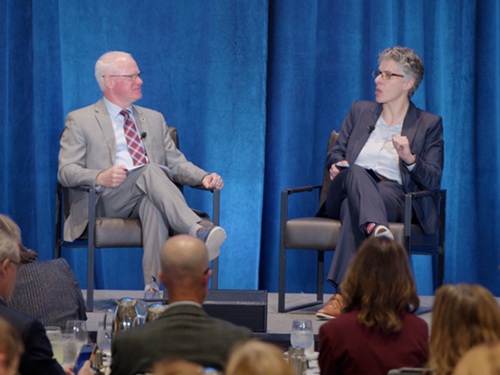 Top Stories
