


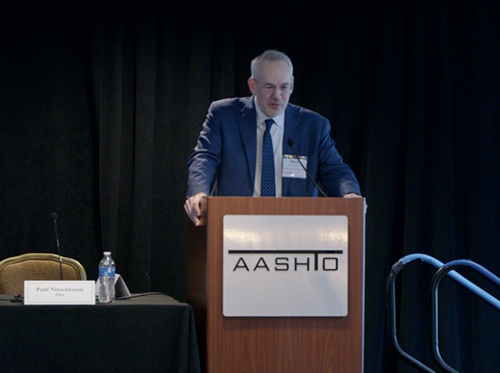
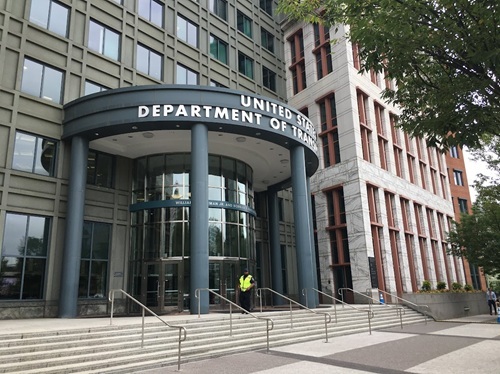
At a recent rail meeting hosted by the American Association of State Highway and Transportation Officials, Paul Nissenbaum (above) – associate administrator and chief development officer for the Federal Railroad Administration – highlighted some of the business process improvement or BPI initiatives his agency is undertaking.
[Above photo by AASHTO]
“Project delivery is really the central focus for us across everything we are doing – we want to move more quickly [on projects] and minimize our touch; only getting involved when and where we need to,” he explained as part of a panel of FRA officials convened at the 2026 AASHTO Council on Rail Transportation Winter Legislative Meeting in Crystal City, VA.
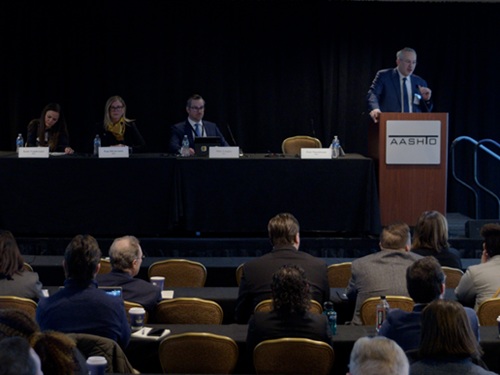
Nissenbaum said the FRA has also consolidated and “synced up” its safety and business development functions across six regions; a restructuring that is going into effect in the next couple of months.
“This is a serious effort we are undertaking – and it is not easy, as we have a lot of statutory and regulatory requirements in place for many reasons,” he said. “We have been doing these kinds of things in different ways for a while, but now we’re making a more formalized BPI effort across FRA.”
Mike Longley – director for the FRA’s Office of Rail Program Development – said one reason underpinning this BPI effort is that many of the management processes used by FRA in the past have become outdated.
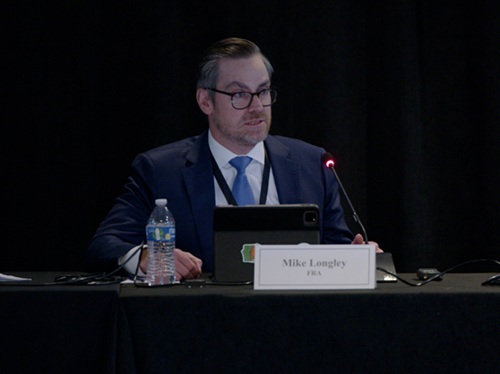
“I’ve worked at FRA for over 15 years and many of the [grant] processes I helped create in 2010 just don’t work well anymore,” he explained.
“That’s why this BPI push across FRA is so important. Our mission is to work with our partners to advance effective rail investments,” Longley noted. BPI is helping us understand pain points and challenges so we can better understand where we need to make improvements.”
Pam DiGiovanni – FRA’s deputy for business process improvement strategy and coordination – added that stakeholder feedback will “be at the heart” of the BPI changes her agency makes make.
“BPI is designed to consolidate feedback to help us drive change,” she said. “It will help guide the development of solutions, prioritizing high impact areas first, and essentially right-sizing the level of FRA oversight for each project based on risk level and other factors.”
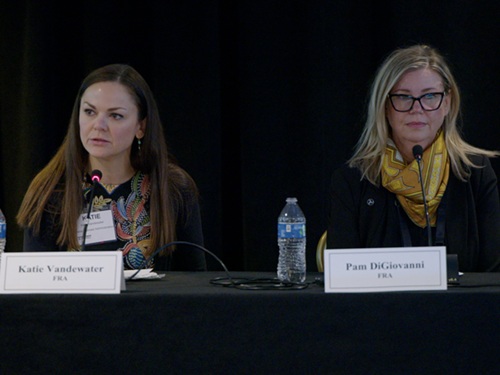
Katie Vandewater – acting chief for FRA’s southeast division – said one example of the advances her agency seeks to make through its BPI effort is how to shorten the grant award-to-obligation timeline.
“Right now, we have a six-to-15-month obligation timeline – that is a very large range,” she explained.
“So, we are working to mitigate or eliminate those delays via an Obligation Timeline Task Force we formed last year to manage this,” Vandewater noted. “We seek to streamline grant agreements through this effort so they become more of a ‘living document’ for projects.”
 Top Stories
AASHTO Comments on 'Corridors of Commerce’ Program
September 18, 2026 Top Stories
