


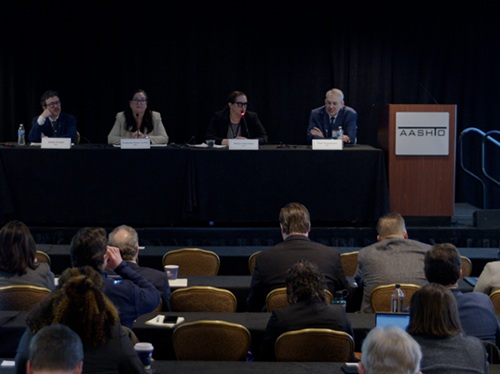
At a recent rail meeting hosted by the American Association of State Highway and Transportation Officials, executives from the Federal Railroad Administration discussed how there’s been a “big sea change” in the environmental review process for infrastructure projects over the last year – including rail projects – and how they are adapting to that new reality.
[Above photo by AASHTO]
“In my 25 years in this industry, I’ve never had this much change in one year,” explained Marlys Osterhues, director of FRA’s Office of Environmental Program Management, at the AASHTO 2026 Council on Rail Transportation Winter Legislative Meeting in Crystal City, VA.
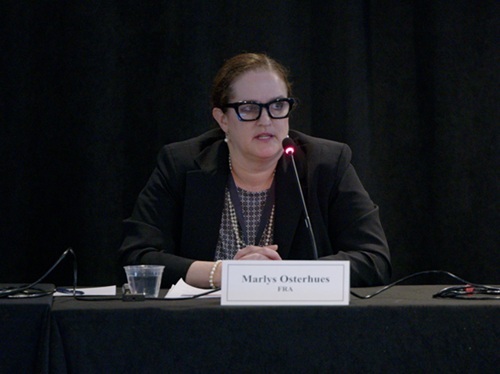
“There has been a big sea change in the environmental review process, with the Supreme Court ruling that [federal] agencies are no longer required to study upstream and downstream effects outside their regulatory control,” she said. “By July 2025, we helped issue a new rule to align NEPA [National Environmental Policy Act] regulations between [U.S. Department of Transportation] modal administrations. And we anticipate further substantive revisions to NEPA via a notice of proposed rulemaking that is expected to be issued in late 2026.”
She said that FRA is now also “aggressively pursuing” dozens of environmental permit efficiency initiatives to help accelerate project delivery. “We’re trying to focus our resources not on routine actions or on those with less environmental impact than on the major ones,” Osterhues said. “We anticipate that streamlining environmental reviews will be a big focus of the surface transportation reauthorization package effort.”
Stephanie Perez-Arrieta, FRA’s environmental review division chief, said the agency is trying to work with more state departments of transportation on “categorical exclusions” or CEs as they can serve as an easier “first step” toward taking on full NEPA assignment duties – especially as many state DOTs already have NEPA assignment experience with other modal agencies, such as the Federal Highway Administration.
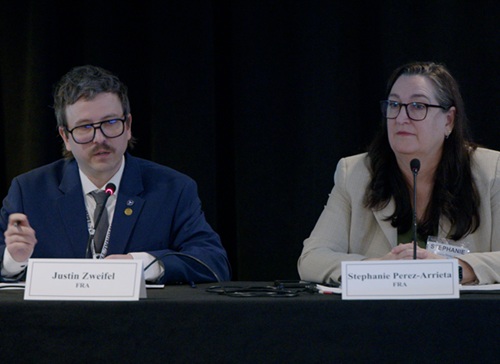
“Because many state DOTs have decades of experience dealing with FHWA in terms of NEPA assignment, we want to take full advantage of that – to give them full control of their destiny,” she said.
Justin Zweifel, FRA’s national team lead, added that the agency is trying to “transform” the CE process as well – leveraging technology to speed up CE reviews and develop new electronic agreements.
“This would standardize decisions by implementing a new CE determination letter while modernizing [CE] tools, forms, and templates,” he explained. “Instead of passing a lot of paper back and forth, we’d go electronic – that would be a pretty big shift compared to the past. We would also increase support to grantees – provide more technical assistance, partner with trade associations such as AASHTO, and leverage USDOT programs to support non-traditional and less experienced grantees.”
Another environmental area FRA is seeking to streamline involves Section 106 responsibilities within the National Historic Preservation Act.
“We are currently engaged with over 12 state DOTs to initiate Section 106 compliance directly – removing duplicative processes,” Perez-Arrieta said. “This shift in process responsibilities to grantees will further help streamline reviews and accelerate project delivery. I’ll also note that that the Advisory Council on Historic Preservation is considering potential Section 106 revisions this year – the first time in 20 years they’ve considered a potential revision.”
 Top Stories
Western State DOT Projects Win Regional Awards
July 24, 2026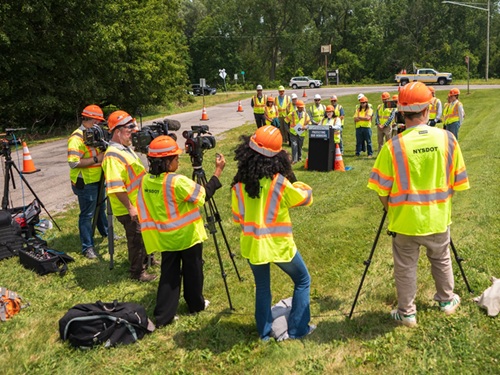 Top Stories
