


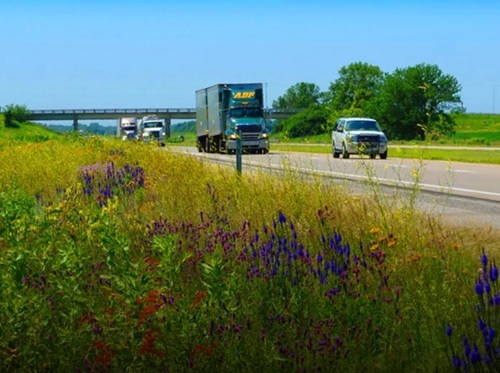
The Iowa Department of Transportation is now accepting applications for fiscal year 2027 Living Roadway Trust Fund or LRTF program grants; a program designed to help cities, counties, and other organizations enhance vegetation on roadsides statewide. Applications are due by June 1.
[Above photo by the Iowa DOT]
Working through many partners in Iowa, LRTF grants support integrated roadside vegetation management or IRVM programs as well as education initiatives aimed at helping the public understand the benefits, use, and care of roadside vegetation – plants that support a variety of pollination activities, the agency added.
Iowa DOT noted in a statement that LRTF grants typically require a match from applicants that meets or exceeds 20 percent of the total project cost.
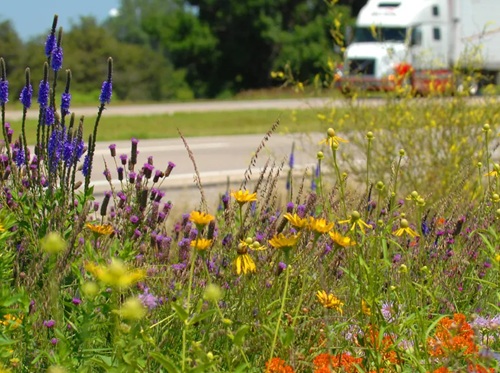
The agency also outlined the specific projects that can receive LRTF funding:
- IRVM implementation and enhancement.
- Establishment and restoration of native roadside vegetation.
- Pollinator habitat development and wildlife enhancement.
- Noxious weed/invasive species control and management.
- Native seed purchase and planting.
- Education, outreach, and demonstration projects related to roadside vegetation management.
- Research, planning, and evaluation projects that support best practices.
Across the country, state departments of transportation are engaged in a variety of efforts to support roadside vegetation needs.
In 2025, the Connecticut Department of Transportation highlighted its ongoing efforts to help pollinators thrive along roadway and other rights-of-way it manages statewide.
Implemented in 2017, the CTDOT pollinator program began with eight sites, encompassing roughly 10 acres. As of 2025, the agency said its pollinator program has grown to 154 conservation areas comprised of approximately 250 acres.
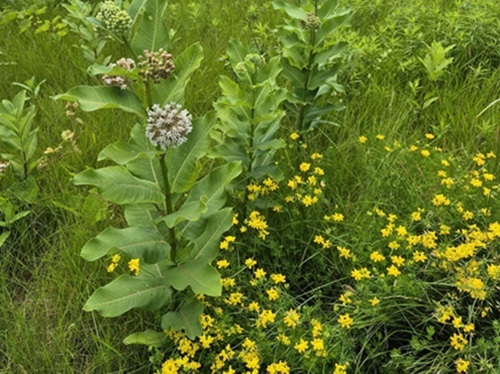
CTDOT noted that the goal of the pollinator program is to provide critical habitats for pollinating insects, such as bees and monarch butterflies, through strategic seeding operations and vegetation management. Those conservation areas are then mowed in the fall, setting the stage for the next growing season.
Farther north, in January 2025, the Michigan Department of Transportation leveraged a grant to transform a parcel of unused land near an interstate rest area into a 14-acre scenic strip of tallgrass prairie designed to attract pollinators.
The agency-owned parcel is south of the Turkeyville rest area on southbound I-69, just west of the right-of-way, and the goal of this project is to create habitat that serves as a “safe refuge for pollinators as well as a connector to other suitable habitat in the landscape.”
To the south, the Tennessee Department of Transportation recently notched year three of its popular Project Milkweed initiative; a program aimed at encouraging the growth of pollinator habitat statewide, particularly the Monarch Butterfly.
Tennessee DOT said Project Milkweed is part of its Pollinator Habitat Program, which it launched in 2017 in response to the sharp decline of pollinator species caused by habitat loss, pesticide exposure, pests, and other threats.
That program brings together a multi-agency partnership that includes the Tennessee Department of Environment and Conservation, the Tennessee Department of Agriculture, and the Tennessee Wildlife Resources Agency.
 States
Chris Dorrington Leaving Montana DOT on October 1
September 3, 2026 States
