


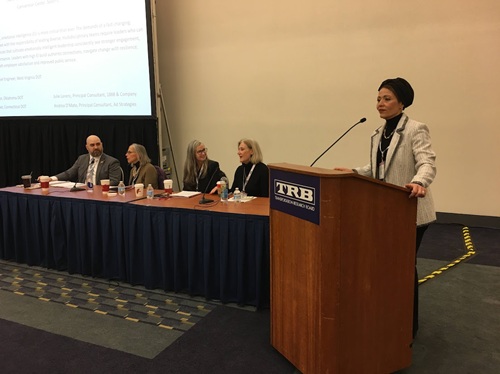
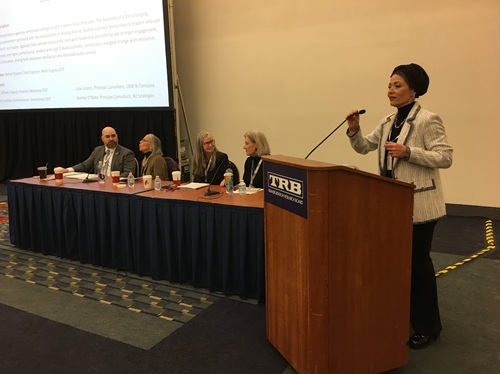
At the 2026 Transportation Research Board Annual Meeting in Washington, D.C., several current and former state department of transportation chief executives discussed how “emotional intelligence” can help leaders better navigate both challenges and opportunities in the infrastructure sector.
[Above photo by AASHTO]
Gehan Elsayed – chief engineer for the West Virginia Department of Transportation and the session’s moderator – explained that “emotional intelligence” is a “defining capability” that directly impacts trust and employee engagement.
“If you invest in it, you will lower turnover, gain higher performance, and strengthen employee engagement,” she said. “It makes organizations stronger over time.”
Garrett Eucalitto – commissioner of the Connecticut Department of Transportation and past president of the American Association of State Highway and Transportation Officials – added that emotional intelligence, “boiled down,” is about the ability to “read the room, listen, and not be impulsive” with a response.
“We have this impression [as leaders] that you need to immediately make a decision,” he explained. “In reality, it is OK to take time to balancing all the inputs. Sometimes, you have to make an emergency decision, but most of the time you need to balance a whole lot of different inputs – internally and externally from the community. That may delay a project, but it will deliver better solutions.”
Eucalitto emphasized that emotional intelligence is key to helping transportation leaders better connect with colleagues, the public, stakeholders, and elected officials.
“I cannot do my job, my agency cannot, unless the public and elected officials trust us, have faith in us, and see that we are producing results,” he stressed. “The key thing here is self-awareness; to be intentional about our strengths and what we are less proficient at. For me, that means my senior leadership is not made up of people like me who think like me. To be successful in my role, I need people with diversity of thought processes, different strengths and weaknesses.”
Eucalitto also noted that emotional intelligence helps leaders to recognize “stressors” and the emotional state of workers. “That has huge impact on work environment. Allowing people to grieve, to take stock of their emotions, so they can make better decisions. We have to be understanding: not judge them if they need a break and to step back. Because, if your head is not in the game – especially in the field – something can go seriously wrong.”
Julie Lorenz – principal consultant with the consulting firm 1888 & Company and former secretary of the Kansas Department of Transportation – emphasized that emotional intelligence is about “pausing” to listen to other perspectives; not that you cannot make decisions.
“It is a soft skill, but that does not make practicing it easy – especially in technical organizations like a state DOT,” she said. “It helps simplify decisions, to get down to the core need – the essential need – of a project, which is how it impacts people’s lives. It helps in the building of projects that stand the test of time by building relationships that stand the test of time.”
Dawn Sullivan, deputy director of the Oklahoma Department of Transportation, noted that emotional intelligence is critical to the “engagement process” for projects large and small – “and it continues before, during, and after construction is completed,” she said.
“State DOTs get stuff done – we call ourselves ‘GSD agencies’ – so project delivery is everything,” Sullivan explained. But starting in 2020 with the COVID-19 pandemic, she said Oklahoma DOT began undergoing “an enormous amount of change” because the agency found itself stuck in same habits.
“We challenged ourselves: Why do we do the things this way? And we started putting people in the middle of what we do – improving their quality of life,” Sullivan said. “So project delivery became not about getting things done, but how are we are improving quality of life? And we needed to explain the why of that.”
Andrea D’Amato, principal consultant for Ad Strategies and former assistant secretary for operational excellence at the Massachusetts Department of Transportation, noted that emotional intelligence is a practice and that the more state DOT leaders use it, the more comfortable they will become with it.
However, echoing 1888 & Company’s Lorenz, practicing emotional intelligence is not easy. “There is no template for it – and that can be intimating,” she explained. “And because there is never an end to the chaos of the real world, every new situation may require a new response.”
Yet that is what emotional intelligence is supposed to help state DOT leaders do better, D’Amato said: manage that chaos.
“It is about connecting, understanding, and engaging with everyone – stakeholders, employees, partners, customers – to help us better navigate the disruption and change which are constants in our lives,” she stressed. “It is not about us – our work is out there. And if we are not connecting and seeking to understand and engage, we will get it wrong.
 Top Stories
Approval Given to Tennessee’s I-24 Choice Lanes Project
August 21, 2026 Top Stories
