


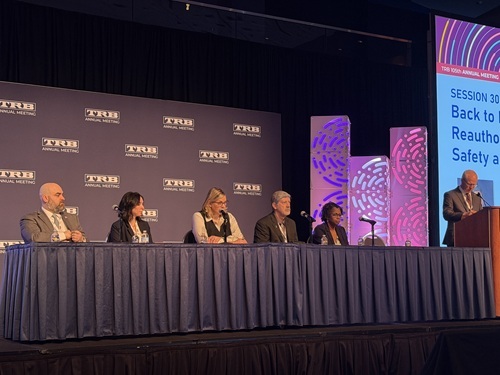
A roundtable session at the 2026 Transportation Research Board Annual Meeting in Washington, D.C., highlighted the key focal points for state departments of transportation as work continues in earnest on the next surface transportation funding reauthorization bill: namely, to prioritize formula funding, improve safety outcomes, and speed up project delivery.
[Above photo by AASHTO]
That session – moderated by Russell McMurry, commissioner of the Georgia Department of Transportation and the 2025-2026 president of the American Association of State Highway and Transportation Officials – also explored how state DOTs successfully delivered infrastructure projects to communities across the country via funding from the Infrastructure Investment and Jobs Act or IIJA of 2021; a package that includes current reauthorization legislation set to expire in September.
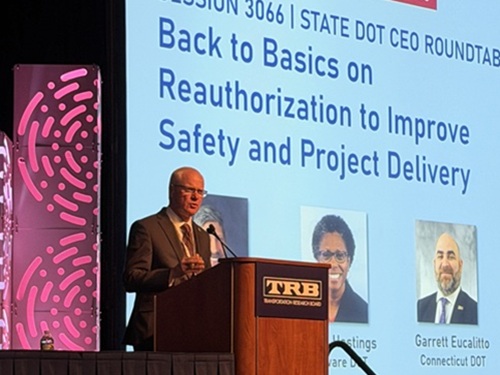
“We’ve been working very hard to get surface transportation funding implemented [from the IIJA] and delivering everything from big to small projects that help communities across the nation improve safety, keep our economy moving, and also to enhance quality of life,” McMurry said.
While he stressed that state DOTs “made exceptional progress in doing these things,” he said there is still more work to do. “We know [federal investment] is critical to fund solutions that save lives and improve mobility,” McMurry noted. “But we also know the reality: That the buying power of each federal dollar has been eroded due to increased cost and volume and often over-burdensome regulations that slow down project delivery. Clearly, that’s increased over the last four to five years.”
He pointed out that the national Construction Cost Index from 2020 to 2024 increased by about 70 percent, while in his home state of Georgia, those costs increased by more than 100 percent to 150 percent for some transportation infrastructure projects.
“This means that we have to find more ways to streamline federal project delivery timelines. That’s really where we’re focused,” McMurry said. “By eliminating some of the bureaucratic processes and duplication of efforts, we can get projects completed faster.
Just think about the [impact of that] on inflationary costs. If we could deliver projects faster, they would not have cost as much.”
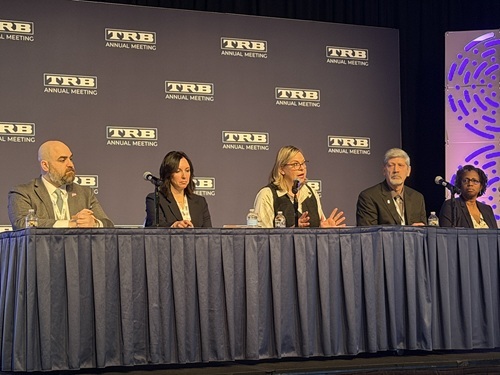
Other state DOT chief executives on the panel endorsed McMurry’s view on the benefits of speeding up project delivery.
“We’d love to see project delivery streamlined – that’s been something that’s been near and dear to my heart,” noted Joel Jundt, secretary of the South Dakota Department of Transportation.
“When it takes you 18 months from when project [funding] has been awarded to physically get it under contract and move it along, that creates issues – especially from the financial side, as inflation continues to expand [project] cost,” he added. “So, streamlining project delivery and then reducing red tape or regulations … are the main themes we’ve been continuing to stress amongst our congressional folks in regard to speeding up project delivery.”
Garrett Eucalitto, commissioner of the Connecticut Department of Transportation and immediate past president of AASHTO, noted that eliminating duplicative rules – especially where environmental regulations are concerned – would help tremendously in terms of improve project timelines.
“We often have to produce environmental documents for separate agencies instead of being able to do it once,” he said. “We encounter significant hurdles where we have duplicative processes and environmental reviews, such as between the U.S. Coast Guard, the U.S. Army Corps of Engineers, and others. So, we’ve been really pushing to try and make it easier; at least by making [environmental rules] interchangeable between different regulatory bodies.”
Yet Shanté Hastings, secretary of the Delaware Department of Transportation, noted that achieving such change requires a lot of “buy in” across the infrastructure construction community – something her boss, Governor Matt Meyer (D), seeks to achieve via the “Task Force on Sustainable Transportation Funding” launched in October 2025.
“Because we are trying to look 20 years ahead, through an executive order, our governor established that task force to really look at what our needs are from an operating side as well as a capital side,” she said.
Hastings serves as the chair of that task force and its 19 members (except for her) are “all folks external to the department,” she stressed.
“It’s people from the private sector, public sector nonprofit, [and] our unions all coming together to come up with recommendations for sustainable transportation funding,” she said. “That task force will meet through the end of this year and will provide some recommendations to our governor and the General Assembly in December.”
Kristina Boardman, secretary of the Wisconsin Department of Transportation, stressed in her remarks that achieving funding stability – especially in terms of the flow of federal funding to the states – is critical to ensuring transportation projects stay on track.
“Just having the stability of knowing what federal funds we will be getting is so important to us,” she explained. “We do not want to be solving problems on a year-to-year basis. Transportation is a long game. We want to be thinking about the future, with a shelf of projects ready to go. That’s why we’re really hoping that we will solve this through the reauthorization process and get back to basics with formula funding.”
Vicki Kramer, director of the Nebraska Department of Transportation, agreed with Boardman that funding remains a critical focal point in the project delivery process.
“As the others have said, funding continues to be a major hurdle. None of us have enough money,” she explained. “That’s a challenge as you try to educate stakeholders both at the federal and state level; what we continue to see is states taking on the responsibility to have the funding that they need more and more.”
She pointed to the impact of the IIJA on Nebraska, which is one of 12 “federal fund swap states,” which means Nebraska actually administers the majority of the funds at the local level.
“My locals had not dealt with federal funds and over 10 years … and this completely changed their processes,” Kramer noted. “And so, following a statewide transportation summit, we launched what we call the Nebraska Infrastructure Hub that helped streamline the entire [infrastructure funding] process for us at the state level, as well as for those local governments – and it is they who get the benefit of that.”
 Top Stories
Mid-America DOT Projects Win Nat'l Competition Honors
August 14, 2026 Top Stories
