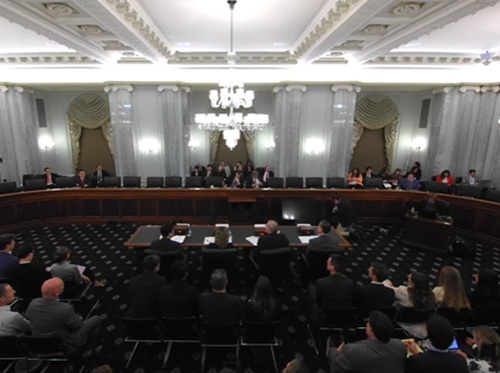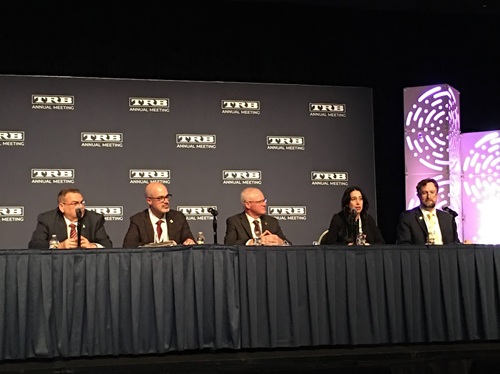
A session at the held at the 2026 Transportation Research Board Annual Meeting in Washington, D.C., examined how a variety of technological innovations can be tapped to deliver a “Golden Age” of transportation for the United States.
[Above photo by AASHTO]
Seval Oz, senior advisor, office of the assistant secretary for research and technology at the U.S. Department of Transportation, kicked off the discussion by highlighting a request for information by the agency to help develop a five-year research plan.
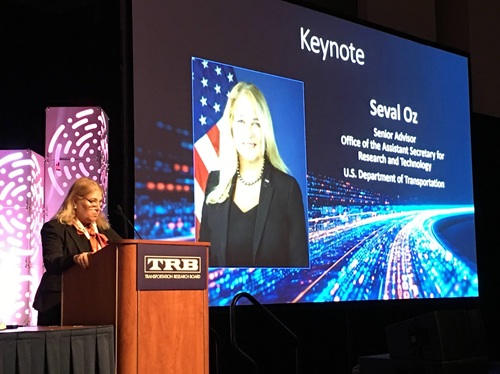
“The USDOT is committed to working across its modal administrations to help support corridor modernization efforts, automation, and the deployment of artificial intelligence,” she said. “Those are just some of technologies we believe will unleash transportation efficiencies – but we need good quality data to do it. Data-informed decision making in real time will help us improve transportation operations as well as safety. And we plan to publish a strategy to guide this in the fall.”
Luisa Guerra-Young, deputy assistant secretary for transportation policy at USDOT, stressed that the “ultimate aim” of the Trump administration is “straightforward” – create a transportation system that is safe, reliable, and efficient.
Where transportation technology is concerned, she noted that the pace of technological change in some areas is occurring rapidly. “ AI [artificial intelligence] models are advancing every month, if not every week – they will be incredibly transformative,” she said.
As a result, Lee White – deputy assistant secretary for research and technology at USDOT – believes the transportation industry as a whole will experience “more disruption and opportunity than we have ever had” in the next five years.
“From a freight perspective, it is going to be about how we improve the whole ecosystem – how we make improvements across the whole supply chain,” he explained. “That is going to position us to compete on a global scale and we will need to leverage digital infrastructure to do that; to help drive cost out of the system, to make us more globally competitive.”
White added that one of challenges in terms doing that effectively is that “while we are really good in working in our own vertical areas, it is the connecting of the whole – the integration – that poses the challenge for technology. It all has to move together as an ecosystem.”
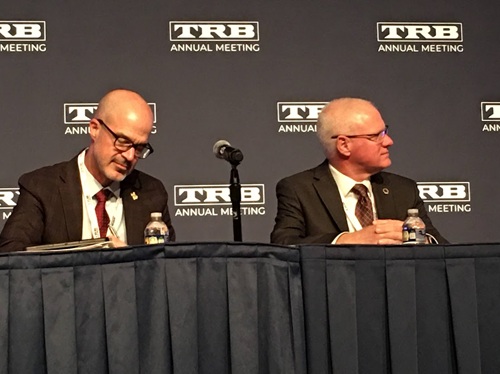
Russell McMurry, commissioner of the Georgia Department of Transportation and president of the American Association of State Highway and Transportation Officials, stressed that technology initiatives to modernize transportation networks must “first and foremost” be about improving safety outcomes and then deliver operational benefits.
“The technology we deploy today will have a major bottom-line impact over next 20 years,” he added. “Because while a 5 percent reduction in travel time might not seem like a lot, when you apply that to over 12,000 trips per day, that becomes a major impact. We want to be ahead of the curve on that.”
Marc Williams, executive director of the Texas Department of Transportation and AASHTO’s vice president, noted that the application of various digital technologies to the U.S. transportation system will really improve risk management capabilities.
“The opportunities offered by digital infrastructure in the area of risk management, that to me is the most tremendous opportunity,” he said.
“It gives us the ability to be more efficient in design and cost estimation – to conduct a more robust life cycle analysis where physical transportation infrastructure is concerned,” Williams stressed. “It allows us to run through the entire process – the design-planning-construction-operation-maintenance cycle – and think about how to improve things before physically building it. That gives us a tremendous avenue to conduct risk mitigation and improve safety.”