


The administrators of the Federal Highway Administration, Federal Transit Administration, and Federal Railroad Administration shared their outlook on the opportunities and challenges ahead for the respective industries they cover in late November at the American Association of State Highway and Transportation Officials 2025 Annual Meeting in Salt Lake City.
[Above photo by AASHTO]
“I just want to start by highlighting how important this critical relationship [with AASHTO] is for not only USDOT, but for FHWA in particular. It has always been a special relationship and I trust it will continue to be that,” noted Sean McMaster, FHWA administrator.

“And I also know all of you [state departments of transportation] have cross-modal impacts. That is why having the support and partnership with my USDOT colleagues here today is absolutely critical to making sure when we look at [transportation] solutions for each state and each community, that we do that from a broader perspective rather than just from one mode,” he said.
“At USDOT, we’re focused on improving safety and working closely with state DOTs to rebuild our nation’s critical and crumbling infrastructure,” McMaster pointed out. “We’re getting America building again, with a large focus on durable projects that enhance safety while connecting our country and our people as part of these efforts. I’m working closely with [USDOT] Secretary [Sean] Duffy and Congress on ways to cut red tape, enhance safety, accelerate project delivery, improve efficiency, and reduce costs.”
He also stressed that “your priorities are my priorities” at the meeting. “Many of you heard me say this but I mean this passionately. I am excited about working with you all over these three years to really knock out a lot of these priorities that you all have; that you need for your communities and your states,” McMaster emphasized. “I want to continue to work to solve problems and accelerate project delivery. Our meeting at USDOT headquarters this July was the first of its kind, but it certainly won’t be the last. I hope to invite all state DOTs back to Washington, D.C., next year to continue our work and partnership together.”
He noted that USDOT’s mission continues to be helping the states “build great things,” which is why McMaster remains focused on helping deliver a surface transportation reauthorization bill that provides adequate funding.
“The department [USDOT] is focused on getting back to basics and building core transportation infrastructure, making family-first investments that prioritize safety, accelerating project delivery, strengthening the nation’s global leadership and transportation innovation, and improving congestion and freight movement,” he pointed out. “The surface transportation reauthorization effort is critical to this mission as the fundamental mechanism for providing the necessary funding. We must ensure reliable, predictable funding by enacting a long-term, multi-year bill that focuses our efforts on addressing our aging infrastructure.”
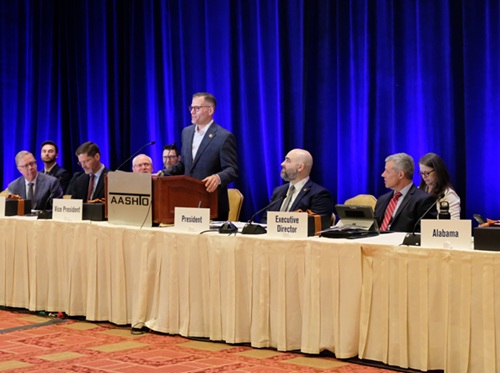
Marc Molinaro, FTA administrator, reiterated the importance of safety not only to his agency but the transit industry as a whole. “Why are we focused on safety here? Because transit, in many ways, is the front porch, if you will, or the face of government to so many families across this country,” he said.
“In fact, in many ways, it is the government service that they have to rely on the most,” Molinaro emphasized. “I enjoy my freedom in a vehicle, traveling highways. But for many families, for those with mobility challenges – and certainly those in our more urban settings – public transportation is a necessary government service. It, however, cannot be reliable if it is not safe. So for us, transit matters because families matter and in order to provide the most reliable, the most efficient, and the most effective transportation system in the country, it must also be safe.”
He pointed out that this is why FTA is “leaning in” with transit system safety audits. “It is why we will continue to use the FTA tools, to incentivize, encourage and to provide resources to both states and transit entities to confront problems,” Molinaro noted. “But we also hope that you, as state DOTs and our partners, continue to help provide safety oversight capacity, in particular in the area of system security.”
He also echoed FHWA’s McMaster regarding the need to increase efficiency when it comes to project delivery in the transit sector.
“We do that by focusing on outcomes, not on process. I’ve said this to my friends in the transit community and as I’ve talked about this [to state DOTs] it is all about outcomes,” he stressed. “Define what success looks like for transit organizations and then tell us how you’re going to get there. It’s why we’ve made reforming our regulatory system and processes a priority. This includes our effort create a standardized categorical exclusion worksheet, which will allow for reviewing and qualifying construction projects and demonstrating environmental compliance a heck of a lot easier.”
Molinaro added that not only are public transportation systems better for the environment, in and of themselves, they help reduce traffic congestion.
“That is why we do not need another layer of measurement to have projects,” he emphasized. “A project in a rural community that moves people more effectively and efficiently is as valuable as the Second Avenue subway in the City of New York. And we want to be sure that whether you are a rural, suburban, or urban center, you are not held to the same regulatory calculation. Rather, can you develop and deliver a transit project effectively and efficiently? And can we partner with you to do it? That’s our priority.”
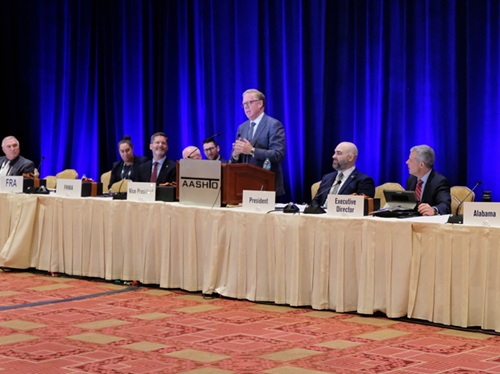
David Fink, FRA’s administrator, added to Molinaro’s “work together” perspective by explaining that “many of your [state DOT] activities and initiatives support improved freight and passenger rail safety, innovation, and development. So we kind of talk the same language.”
He noted that FRA has two core mandates. “The first is to promote safety in the railroad industry and, second, to support the development of infrastructure that underpins a modern, efficient rail network,” Fink explained. “These goals are not separate. They go hand in hand. However, safety comes first for a reason and it will be my primary focus as FRA administrator. As a result, we are looking at, and encouraging, the use of technology to make our railroad system safer.”
He added that FRA’s safety and efficiency focus is also “all about fixing railroads – small railroads and large railroads alike – and making things safer for our entire nation’s railroad system. We want to work with project partners to find ‘win-wins’ that will improve the safety and efficiency of our nation’s rail network.”
Fink noted that freight railroads are working better now with public transit agencies and with other railroads that are interested in passenger service as well, and while there are still issues – such as with insurance and infrastructure – where the “win-wins” are, the railroads are stepping up.
“We need to deliver projects on time and on budget, and though we’re really struggling with construction [cost] inflation, by working together cooperatively and collaboratively with USDOT and the states, we will certainly see more of that across the country,” he said.
 Top Stories
AASHTO Comments on 'Corridors of Commerce’ Program
September 18, 2026 Top Stories
